



1. From Diagnosis to Capability
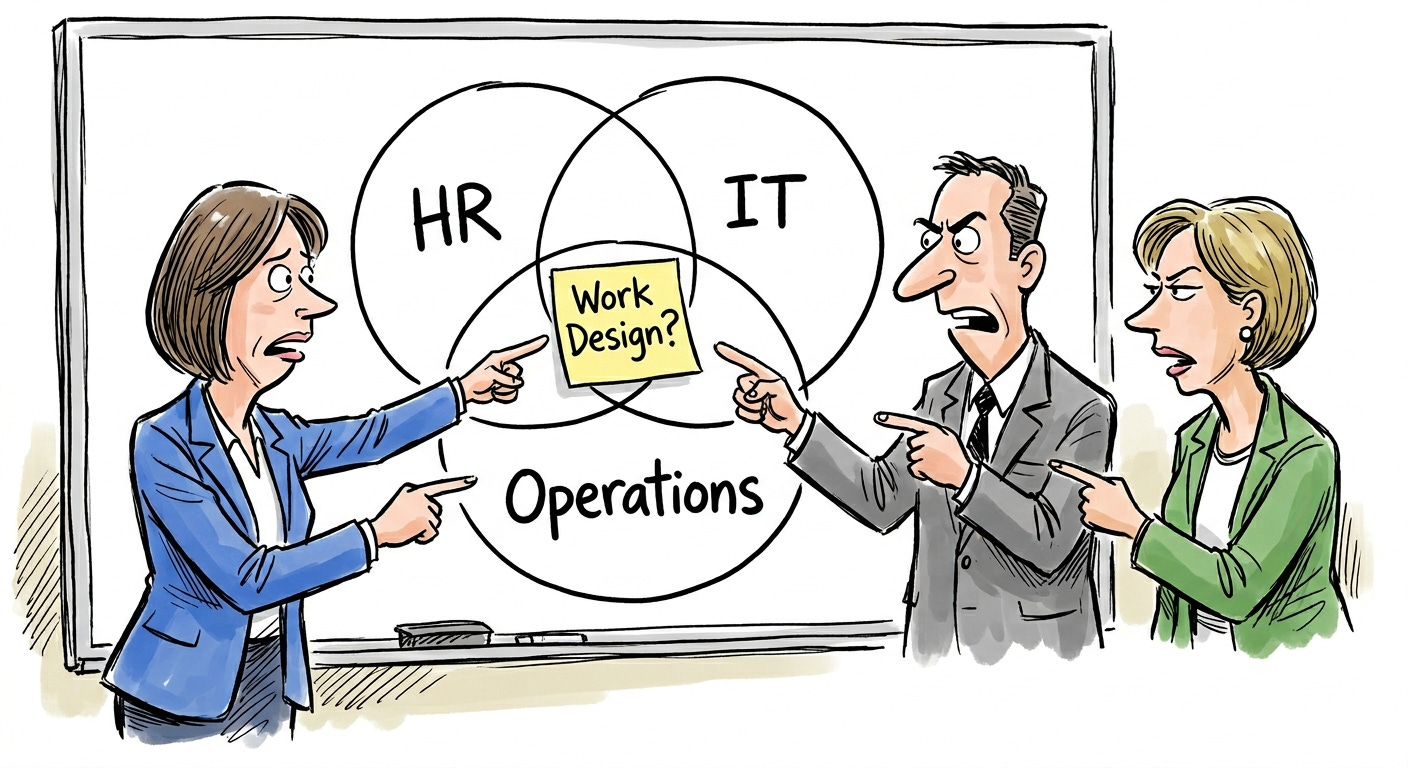
The conversation I keep having goes like this. Someone at the leadership table raises an AI deployment that is not working — the productivity gains are not showing up, teams are frustrated, the vendor is blaming implementation. Discussion moves quickly to what’s actually wrong. *The work around the tool was designed for a pre-AI process. Nobody redesigned it.* The room agrees. Then: so who should fix this? The room gets quiet. IT points to process. Operations points to HR. HR points to Strategy. Strategy points back to the business. Nobody has the brief.
That quiet is what this issue is about.

Where we are
Issues #49 and #50 established the diagnosis: the gap between what AI can do and what AI is producing inside organisations is not a technology gap. It’s a design gap — specifically, the absence of anyone who owns Work design as a discipline, with the seniority and the cross-functional brief required to actually redesign how Work flows across the enterprise. The J-curve of general-purpose technologies — documented across steam, electricity, computing, and now AI — requires complementary investments in process redesign, organisational restructuring, and new governance before the productivity shows up in the data. Those investments require someone accountable for making them. That someone, in most organisations, does not exist.
So the question shifts. It’s no longer is there a design gap? That’s answered. The question is: what kind of capability would actually close it?
The capability that already exists
Before reaching for something new, I want to take the counter-argument seriously. A reasonable observer would say: we have had strategic workforce planning for decades. We have L&D functions, transformation offices, centres of excellence. The capability is not absent — it is distributed.
That’s right, and that’s the problem.
Strategic workforce planning is the closest institutional cousin to what I’m describing — the discipline that’s supposed to translate business strategy into capability requirements and then decide how to source them. Most organisations run some version of it. And in most organisations, it has been captured: absorbed into the Finance cycle (annual headcount, not continuous rebalancing), filed into the HR taxonomy (job families and pay bands, not capability as an asset class), and redirected toward compliance reporting (who has what licence, not who can do what work). The vocabulary of strategic workforce planning invokes portfolio thinking — buy, build, borrow — but applies it transactionally, one decision at a time, without the strategic logic the framing requires.
The capability exists in name. The discipline has been institutionally defanged. This is not an absence problem. It is an institutional capture problem — and the implication is different. The argument is not for building something new. It is for reclaiming something existing and granting it the mandate it was never actually given.

Treating capability like a portfolio
The framing that keeps returning — and I have tested several — is portfolio management. Not as a metaphor — as a discipline imported in full.
A portfolio manager cannot simply want more of everything. They allocate under constraint, make trade-offs explicit and visible, rebalance as conditions shift, and are accountable for the portfolio as a whole. Portfolio discipline is how pension funds, infrastructure managers, and R&D leaders handle assets that are large, slow to build, and strategically important. Organisational capability is all three of those things — and is almost never managed with the equivalent discipline.
Applied to capability, portfolio management imports four things most organisations currently lack:
Explicit trade-off reasoning. Every buy/build/borrow decision is a trade-off between cost, speed, quality, and strategic dependency. Most organisations make these implicitly, defensively, or under budget pressure — which means the trade-off gets made by whoever happens to be in the room, not by whoever is accountable for the outcome.
Continuous rebalancing. Financial portfolios are not reset once a year at budget time. Organisational capability needs the same continuous recalibration — especially under AI adoption, where the relative value of specific capabilities can shift within quarters. Annual headcount planning is the wrong cadence for a problem that moves at this speed.
Risk as an explicit dimension. Borrowing capability heavily hollows out institutional knowledge. Building it heavily creates lock-in. Buying it heavily disrupts culture. These second-order effects are predictable — but they only become visible if someone is holding the whole portfolio picture and asking about them explicitly.
Executive ownership at the level where trade-offs can be made. A portfolio has a manager who is accountable for the whole, not for individual line items. Organisational capability is currently split across HR, line management, Finance, and procurement — with no one holding the integrated picture, and therefore no one able to make the integrated call.
The portfolio framing does something that the existing language of strategic workforce planning does not: it creates a named accountability gap that cannot be dissolved into shared responsibility. Portfolio management requires a portfolio manager — not a committee, not a dotted-line arrangement across Finance and HR, but a named role accountable for the whole. The moment you apply the discipline in full, the question of who holds it becomes unavoidable. Strategic workforce planning never forced that question because its vocabulary always fitted inside the existing functional silos — headcount to Finance, job families to HR, licences to IT. Capability Portfolio Management does not fit in any of those containers.
This is not a speculative claim. Three decades of research on dynamic capabilities — following Teece, Pisano, and Shuen’s foundational work — has established that organisations capable of continuously sensing and reconfiguring their capability base outperform those that manage capability reactively. The portfolio management discipline is the institutional instrument that makes reconfiguration systematic rather than episodic. Without it, even organisations that understand the diagnosis will keep responding to capability gaps one project at a time.
This is the governance gap inside the design gap.
What holding the brief actually requires
If you were to design the institutional home for Work design — the role, function, or mandate that would actually hold this — what would it need?
At minimum: authority that spans HR, IT, Operations, and Strategy simultaneously, not sequentially. A seat at the executive table — not a project team, not a centre of excellence reporting into someone who attends that table. A mandate that is continuous, not episodic — the capability question does not get answered once and stay answered, any more than a financial portfolio gets set once and left alone. And, perhaps most uncomfortably, a willingness to redesign the function’s own role as the Work changes.
The direction that emerges from practice is that this sits closer to the Operating Model layer than to HR as currently constituted. The framing that is gaining ground is direct about what it requires: shed compliance and pay administration to Legal and Finance; invest the freed headroom in Work design and transformation capability. Be the architect of Work design, not the administrator of job families. This is not an HR-only argument — it is an Operating Model argument that happens to have large consequences for HR.
Other disciplines have faced analogous transitions. Infrastructure management learned the difference between repairing a road and maintaining a highway system — the former is reactive and episodic; the latter is a continuous discipline with accountable ownership, risk monitoring, and strategic rebalancing. Behind the failure to maintain is almost always a capex/opex trap: repair shows up as capital spend and is visible; ongoing maintenance disappears into operating cost and gets cut first. The result is you fix the road only when it has deteriorated past viability — and you pay for it twice. The portfolio discipline holds both in view simultaneously, which is exactly what organisational capability management currently lacks. Healthcare systems learned the difference between treating individual patients and building diagnostic capacity — the former scales linearly with effort; the latter builds something that compounds. The Work design capability is in that second category. You cannot outsource your way to it one project at a time.
One concrete signal to watch for: when an organisation requires managers to analyse task structure before requesting headcount — as the Shopify internal AI mandate did— it is treating Work design as a governance instrument rather than a departmental concern. Whether or not Shopify sustains this, the signal matters. It tells you that the question of *what kind of work actually needs doing* can be made into a governance question — that the design layer can be given enough institutional authority to reshape how resources flow.

A different signal, different register: at Microsoft, product development teams went through Camp AIR — a three-week programme with protected time, internal coaches, and a shared set of AI tools, with the brief to figure out how to work differently, not to ship the next feature. Old working patterns were deliberately suspended before new ones could take hold. The programme is work design as a governance instrument: time and authority explicitly carved out so that redesign happens before existing practices reassert themselves.
This is a necessary precondition, not a full solution. Naming the governance gap does not dissolve the political economy that created it — the functional silos, the budget cycle orthodoxies, the HR mandate set in a different era. The argument here is that portfolio management is the right framing for the capability; making that framing stick in a real organisation is a different challenge, and one this newsletter will return to.
Where this takes us
The capability has a name: Capability Portfolio Management. The mandate is available. The institutional logic — portfolio management of organisational capability, held at the executive level, with a continuous brief and a cross-functional authority — is not exotic. It exists in adjacent disciplines. What is missing is the will to claim it for Work, and a clear enough picture of what claiming it actually involves in practice.
That is where this newsletter is going next. Not as a theory — as a working account of what the discipline looks like when someone is actually holding it, what it requires from the people who hold it, and what it demands from the organisation that grants it.
Sergio
2. Site Updates
The Laws of Organisation Design series is running again on the blog. One more piece added:
More to follow. If you find the productivity argument in this issue interesting, the Laws series is the slower, more structural companion to it.
Also available the recording of a Podcast: People is Not an Option | AI and HR: Why This Is a Cultural Problem, Not a Technical One
3. Reading Suggestions
Redesign first. Then AI just works — Jared Spataro, Microsoft.
The clearest practitioner argument for work redesign as a precondition of AI adoption, not an alternative to it. The Camp AIR programme described here — three weeks of protected time to map and redesign work before old practices reassert themselves — is what treating work design as a governance decision looks like from the inside of one of the world’s largest AI deployments.
What Is Strategic Workforce Planning?— Bain & Company.
The clearest practitioner articulation of workforce planning as a discipline rather than an exercise. Read against the argument in this issue: the framework is correct; the institutional reality it describes is the defanged version of it.
World of Work Trends 2026: The Intentional Organisation — Top Employers Institute.
The “intentional organisation” framing has entered mainstream HR research. Worth reading for what it gets right (design intentionality as performance lever) and what it leaves underspecified (who holds the brief).
The New Era of Workforce Planning — SHRM.
SHRM’s survey of where strategic workforce planning actually sits in organisations today. The diagnosis of why it keeps getting captured by headcount planning is useful confirmation from a different angle.
4. The (un) Intentional Organisation 😁
5. Keeping in Touch
Don’t hesitate to reach out by directly hitting “reply” to this newsletter or using my blog’s contact form.
I welcome any feedback on this newsletter and the content of my articles.
Find me also on: