


1. The Design Question Nobody is Asking
Long time no see. No excuses, my work simply absorbed too much time. Returning today with this issue of The Intentional Organisation newsletter feels right. May 1st, Labour Day: the right moment to reflect on Work holistically, not just as a list of tasks. I’ve been thinking a lot on this recently, being immersed daily in a flow of reflections on productivity, impacts of market dynamics on our organisation, and trying to understand the real impact of AI transformation behind the hype.
That’s why I would like to re-start this newsletter with Work itself, and the conversation I keep finding we are not having about it.
The dominant discussion about AI and Work
I’m sure you have also had the impression that the discussion about AI and Work has been dominated by two fields of analysis:
The productivity camp: with tools promising extraordinary efficiency gains, vendor decks full of percentages, companies advertising cuts of jobs “thanks” to AI…. although data seems to indicate these gains are in reality yet to be materialized, and most of it seems rather being a investor-pleasing AI-washing maneuver.
The labour-economics camp: looking at macroeconomic level what jobs survive, which ones will disappear, what speed replacement actually happens.
Both conversations are serious. Both are producing useful evidences. And both, taken together, are completely skipping the core question that actually determines outcomes inside organisations.
The Two-Speed Problem
Look at what’s actually happening inside companies right now and you see a split.
Speed 1 is individual productivity gain from AI tools. Most knowledge workers have access to a copilot of some sort, and use it daily. This is moving.
Speed 2 is workflow and operating model redesign enabled by AI. This is mostly not moving.
The data here is striking. 88% of organisations report deploying AI, yet 86% say they are not properly prepared to embed it into daily operations. The same report frames the broader shift as a move from Structure to Flow — a recognition that the traditional productivity plays (restructuring, delayering, cost cuts) are hitting diminishing returns, and that what comes next is redesigning how work moves across the enterprise.
That second piece — how work moves — is exactly what the Operating Model is about. It’s the layer where systems, processes, people, and technology are supposed to cohere. AI is precisely the kind of intervention that stress-tests this layer. And the stress test is currently being failed.
Why Work Design is the missing capability
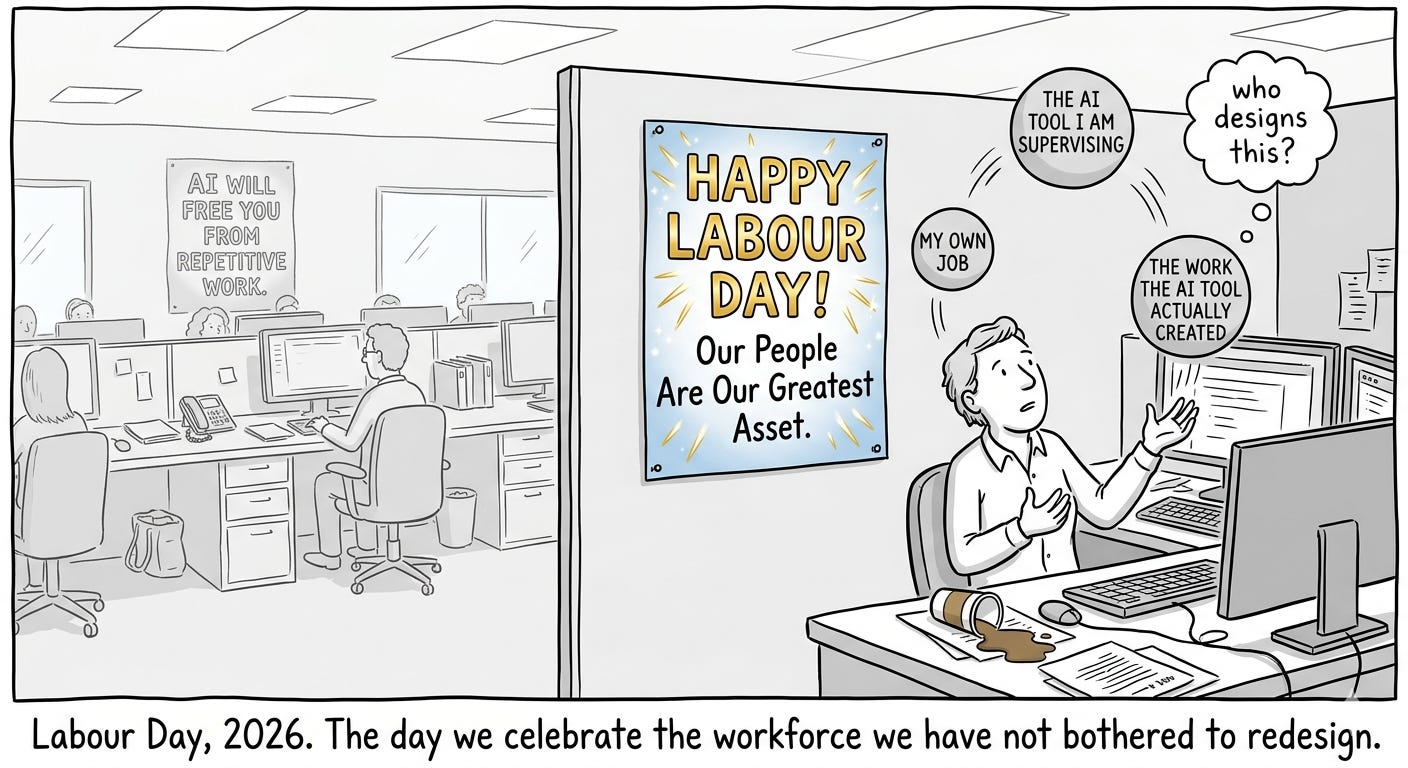
Ask most organisations a deceptively simple question — who designs work here? — and you’ll usually get a long pause and a list of partial owners. HR owns roles. IT owns systems. Operations owns processes. Strategy owns outcomes. Nobody owns the design.
This was a tolerable arrangement when Work changed slowly. It’s becoming an expensive one now. Three things, briefly:
AI lands in the wrong layer. Deploying AI into a process designed for non-AI conditions produces the result you’d expect: the technology works, the productivity does not show up, and the organisation concludes the tool was over-promised. The tool is probably fine. The work around it was designed for constraints the tool removes, and nobody has redesigned the work. The 170-year-old org chart is being asked to absorb a technology that operates at the task level, not the job level.
The capability has no home. Redesigning work requires a working understanding of HR, IT, Operations, and Strategy at once, and the senior leaders who could in theory hold it have usually been functionally specialised away from it for two decades. Work design is everybody’s problem and therefore nobody’s job.
Decision authority has already migrated. This is the one most organisations have not yet noticed. Whoever controls AI system parameters, training data, and thresholds is shaping decisions that business leaders are nominally accountable for — usually IT, a small data science team, or a vendor. The leaders who own those decisions on paper often don’t know what the systems are optimising for.
This is the design gap. It’s not a technology gap — the technology is mostly available, mostly working, mostly affordable. It’s not a strategy gap either — most boards understand, at the slogan level, that AI matters. The gap is in the capability to redesign Work itself: to take a process and rebuild it around a different set of constraints, with a clear view of how the Operating Model and the Organisation Model need to move together for the redesign to hold. Without that capability, AI adoption defaults to what we are seeing now: structure remaining, flow deteriorating.
Where this newsletter is going
I won’t pretend I have the full answer. I do think the question deserves to be named clearly, and I think the next decade of organisational performance will turn on whether we get serious about it. So the next twelve issues of this newsletter are going to circle this terrain — what Work design actually is, why it has no home, what the productivity evidence really says about AI, and what a Listening Organisation might look like once you take the design layer seriously.
Next time, the productivity numbers. The evidence is more sceptical than the headlines suggest, and the gap between capability and outcome turns out to be a design problem, not a technology problem. I’ll show you why.
Sergio
2. Site Updates
A note on the site itself: sergiocaredda.eu hasn’t been updated in some time, and I’m aware of it. The blog rework is one of the things on my list for the next few months, and the Organisation Evolution Framework page itself will be revised as part of that work.
One thing that has stayed alive is the Leadership Models Collection, which I’ve continued to expand quietly through this period. Most recently I added entries on Multipliers, Humble Leadership, Host Leadership, Complexity Leadership Theory, and Resonant Leadership. It’s becoming a useful reference resource on its own, even ahead of the broader site refresh.
3. Reading Suggestions
Why AI Isn’t Fixing Work — And Why It Can’t Until We Rethink How Work Is Designed — Donna Scarola. The single best piece I’ve read this year on the design-gap argument. Opens with the 1854 origin of the modern org chart and walks through why a structure designed for industrial coordination cannot absorb a technology that operates at the task level.
Working Theory: AI Work Redesign — NOBL. A long, evidence-led notebook arguing that AI deployment is a work redesign problem, not a technology problem. Published in the open and updated quarterly — a model worth more imitation than it gets.
The State of Organizations 2026: From Structure to Flow — McKinsey. Mainstream consultancy validation that the design layer is broken. The diagnosis is sharper than the prescription, but that’s exactly why it’s worth reading.
4. The (un) Intentional Organisation 😁
5. Keeping in Touch
Don’t hesitate to reach out by directly hitting “reply” to this newsletter or using my blog’s contact form.
I welcome any feedback on this newsletter and the content of my articles.
Find me also on:
Excellent article, Sergio.