


1. Capabilities in Search of an Owner
I already wrote that, in most organisations, nobody holds the brief for Work Design. Any conversation touching the topic would go quiet at exactly that point — the moment someone at the leadership table asked so who fixes this? HR looks at IT, IT looks at Operations, Operations looks back at the business, and the question dissolves into a shared project, which is another way of saying no responsibility at all. Something that is getting more acute with AI implementations and the need to look into treating this as an organisational issue, not an adoption problem.
That silence is still there. And with it, the need to design the capabilities that should underpin an organisational adventure into AI. What is happening is that a lot of individuals are practicing with these new tools, developing insights, creating agents, reviewing governance models. Every LinkedIn post recently has been framing this: AI is creating “personal productivity”, but this is not scaled at organisational level yet. This also means that skills and capabilities are getting formed in many organisations as we speak. But there is no design behind these, no architecture, no plan, no connective tissue.
It reminded me of Luigi Pirandello’s Sei personaggi in cerca d’autore. Pirandello’s six characters wandered a stage looking for an author to complete them. Similarly, these critical capabilities that we miss collectively are wandering the org chart looking for someone to hold them and nourish them.
But someone has joined them in the room. Three real executives, at three serious companies, each now holding a different hypothesis of the answer. Same question, three different structural solutions — and the reason this issue exists is that all three, to me, feel incomplete in the same way.
Three answers that are already live
I’m sure you have read a lot about them. In many ways, my reference is not only to the people themselves and the roles they are now doing, but more to the noise of commentators around these. Here the cases I’m referring to.
When Moderna folded IT into HR under Tracey Franklin — now Chief People and Digital Technology Officer — it gave one leader the brief to “architect the flow of work”, with 3,000-plus custom GPTs running alongside roughly 5,800 people and the CIO role absorbed. This is the merger answer. Its limit is that merging two functions does not necessarily settle who owns Work Design — it builds a larger silo under a single budget, and the design question survives inside it.
ServiceNow took a different route, making Jacqui Canney Chief People and AI Enablement Officer: HR identity preserved, AI enablement bolted explicitly onto the brief. This is the expanded mandate answer. Its limit is that a title can expand without the authority underneath it changing at all — it may be a signal with no substance, depending entirely on what the mandate actually lets the holder decide.
Microsoft did the most revealing thing of the three. It moved Kathleen Hogan out of the Chief People Officer role into Chief Strategy and Transformation Officer. Not a rename — an exit. This is the migration answer, and it is less a solution than a tell: the most capable people leaders are not relabelling HR, they are leaving it for strategy. Which suggests the ceiling on the brief is the function itself, not the title on the door.
The difference that matters
Each of these is an intention — a course of action, taken. What none of them formalises is the intent — the purpose the action serves, written down as a brief someone is accountable for holding. I drew that distinction a few years ago, almost as a language game; it has never been more load-bearing than it is here. Three organisations have acted intentionally, but in the weak sense. And none of them has named the intent.
The market is enlarging this scope faster than anyone is naming it. Spencer Stuart, surveying 101 European HR executives, found that 43% of CHRO roles now carry responsibilities outside the classic HR remit, and that the expanded remits come bundled with shorter tenures and higher intensity. That is a headhunter describing demand, not a consultancy describing aspiration — which is exactly why it is worth trusting. The scope is growing whether or not the org chart admits it.
The objection I take most seriously
The strongest argument against the way I am framing this comes from Phil Kirschner, who says the integration everyone keeps describing is missing its third dimension. HR thinks about people. IT thinks about tools. Nobody owns place — corporate real estate has no stable home in the org chart, drifting between Finance, HR, and the COO. The brief, he argues, is People plus Technology plus Place, and AI raises the stakes of physical space rather than lowering them: once the coordination overhead is automated, the only question left is which rooms are actually worth being in. Sharon Doherty already carries the title Chief People and Places Officer at Lloyds. Kirschner’s model for the role is deliberately modest — a Fitbit for the organisation, a pit crew — something that makes the cost of misalignment visible without trying to command it.
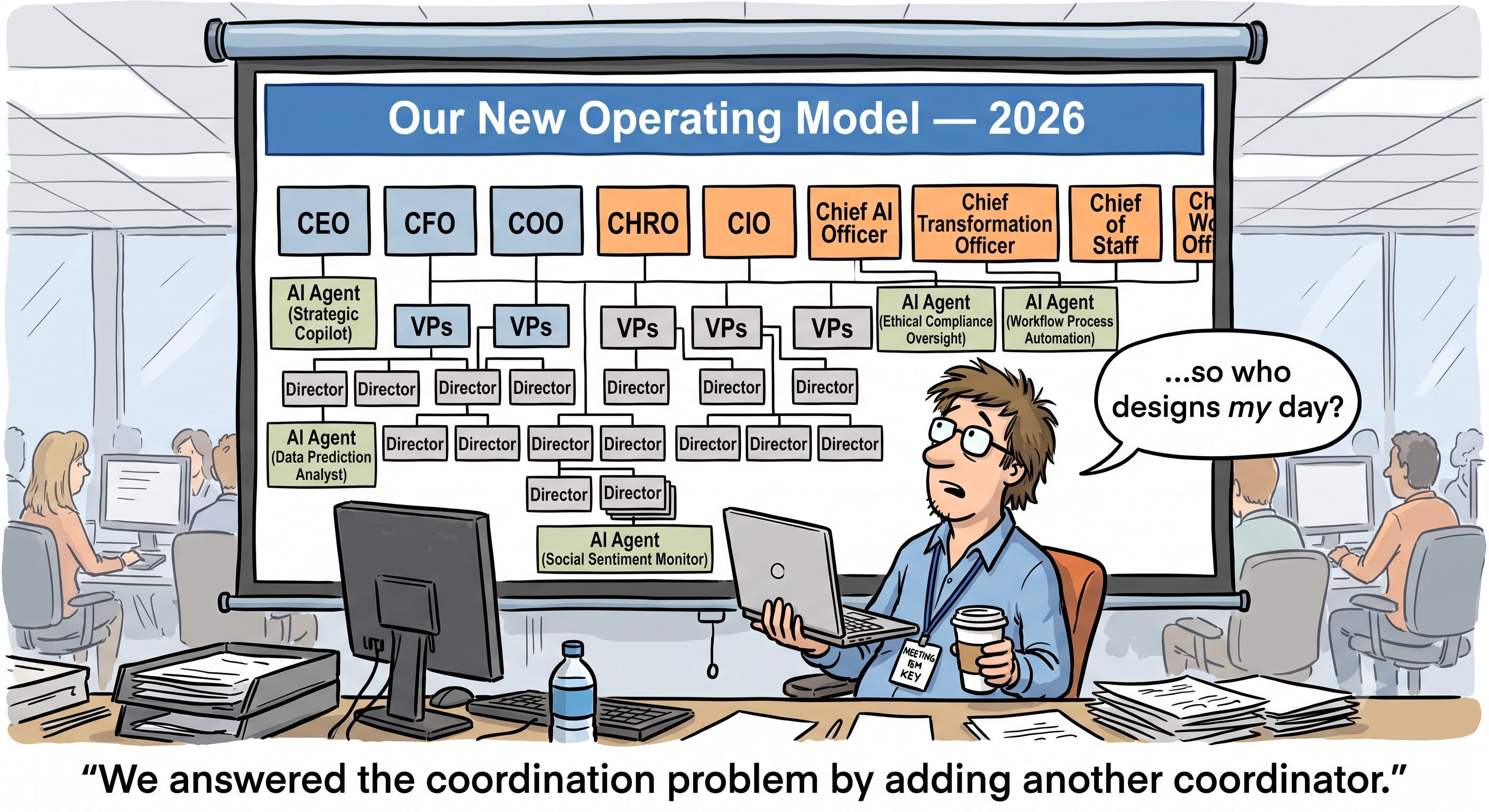
He is right about place (it’s a real dimension of Work Design, and one that has been changing a lot since the Pandemic and the quarrels about remote work), and is also right that this is where the framing gets dangerous. Because every time we answer a coordination failure by appointing someone to own it, we risk manufacturing yet another silo rather than removing a gap. The C-suite has been growing new titles for a decade — Chief Digital, Chief Transformation, Chief AI — and a Chief of Work that simply sits beside the CHRO and the CIO, instead of changing what they are accountable for, is one more coordinator, not one fewer gap. The proliferation of “Chief of…” titles is itself a symptom of the disease it claims to treat.
Where I land
So the answer is not a new title. It is a brief — and the discipline to hold it as one accountable mandate rather than three borrowed ones.
But naming the brief is not the same as being able to hold it. Here is where the three answers we have seen above fail. Each fixes a layer: Moderna the boxes, ServiceNow the title, Microsoft the person. But the real gap is none of those. The mandate has outgrown the model underneath it: the reporting lines, the shape of the HR function itself, the decision rights over headcount, tooling and space were never built to carry a brief this wide. Redraw the org chart and you reproduce the gap, because the thing that actually needs redesigning is the operating model.
Holding the brief, concretely, means owning that layer: the authority to rebalance the capability portfolio, not merely the accountability to describe it.
And there is a harder gap underneath even that one, the one this arc of newsletters has circled without quite naming.
Whoever holds Work Design has to hold it knowing what work actually means to the people doing it: not a configuration problem, but a source of meaning, identity, and sometimes dignity. That is where these pages will go next.
This issue closes an arc of newsletters dedicated to capabilities and configurations supporting AI, not as an objective, but rather as a “disturbance” element that is re-framing how we approach organisations. I have now asked the question of who owns Work Design, and have provided evidences and named the issues underpinning this Big Hairy Question across issues 49 to 55. And have found that I am not alone…
Work Design is becoming a more widespread context for many commentators lately.
If you sit in an organisation that has tried to hold this brief as one job — or tried and watched it fragment back into three — or maybe experimented with an alternative governance model — I would genuinely like to hear what that looked like. Send a comment or hit reply.
Meanwhile, I’ll sit on stage like the Father in Pirandello’s pièce — pleading, incomplete, a little undignified by this situation — still looking for my Author.
Sergio

References
Maguire-Vielle, C., & Wilhelm, B. J. (2026). More than HR: The Rise and Rise of the CHRO. Spencer Stuart.
Kirschner, Phil. “Chief of Work Role and Responsibilities | The Workline.” Blog. The Workline, April 16, 2026. https://walktheworkline.com/article/what-i-now-believe-about-the-chief-of-work.
2. Site Updates
A note on the site itself: sergiocaredda.eu hasn’t been updated in some time, and I’m aware of it. The blog rework is one of the things on my list for the next few months, and the Organisation Evolution Framework page itself will be revised as part of that work.
One thing that has stayed alive is the Leadership Models Collection, which I’ve continued to expand quietly through this period. Most recently I added entries on Multipliers, Humble Leadership, Host Leadership, Complexity Leadership Theory, and Resonant Leadership. It’s becoming a useful reference resource on its own, even ahead of the broader site refresh.
3. Reading Suggestions
Self-Determination Theory in Work Organizations: The State of a Science — Edward Deci, Anja Olafsen & Richard Ryan, Annual Review of Organizational Psychology and Organizational Behavior. The definitive synthesis of why autonomy, competence and relatedness — not incentives — drive motivation at work. The evidence base sitting underneath the question this issue only opens: what work actually means to the people doing it.
TBM 430: Incubate, Compound, Refinance, Liquidate — John Cutler, The Beautiful Mess. Cutler treats a software estate as a portfolio of assets, each facing a live decision to grow it, fix it, or retire it. The cleanest external mirror I have seen of the capability-portfolio logic this arc has been building — the same discipline, pointed at code.
Cathedral Projects — Margaret Heffernan. On work that outlasts the people who start it, and what it takes to commit to something you will never see finished. A useful counterweight to an org-design conversation that usually stops at this quarter’s reorg.
The Great Talent Recalibration — Bain & Company. Shrinking workforces, tighter capital and automation are pushing the CHRO from managing employees to designing a workforce that blends humans and machines. The demand-side case for exactly the expanded brief this issue is circling.
The Paradoxes of the Knife — Dave Snowden, The Cynefin Co. On pruning: the hard, context-dependent judgement of what to cut so that something else can grow. Read it beside this issue’s claim that holding the brief means deciding what to shed, not only what to own.
4. The (un) Intentional Organisation 😁
5. Keeping in Touch
Don’t hesitate to reach out by directly hitting “reply” to this newsletter or using my blog’s contact form.
I welcome any feedback on this newsletter and the content of my articles.
Find me also on:
Excellent piece! I think your diagnosis is spot on. It seems to me the key to closing the ownership gap is to equip and empower the leaders to own the work and act as architects.