



1. The Work Left Behind
The operating model assumption behind most AI deployments runs something like this: AI handles the routine, humans move to higher-value work, productivity follows. Issue #51 showed why the governance infrastructure for that transition is missing. But before governance, there is a more immediate question — what actually happens to the people inside organisations that deploy AI without redesigning the work?
The answer is not what the story predicts. And the majority of organisations are running the experiment without knowing it: Deloitte’s 2026 State of AI in the Enterprise found that 54% of organisations are now scaling AI projects to production — but only 30 to 34% are deeply redesigning jobs. Most are applying advanced AI to unchanged human workflows.
The Residual Task
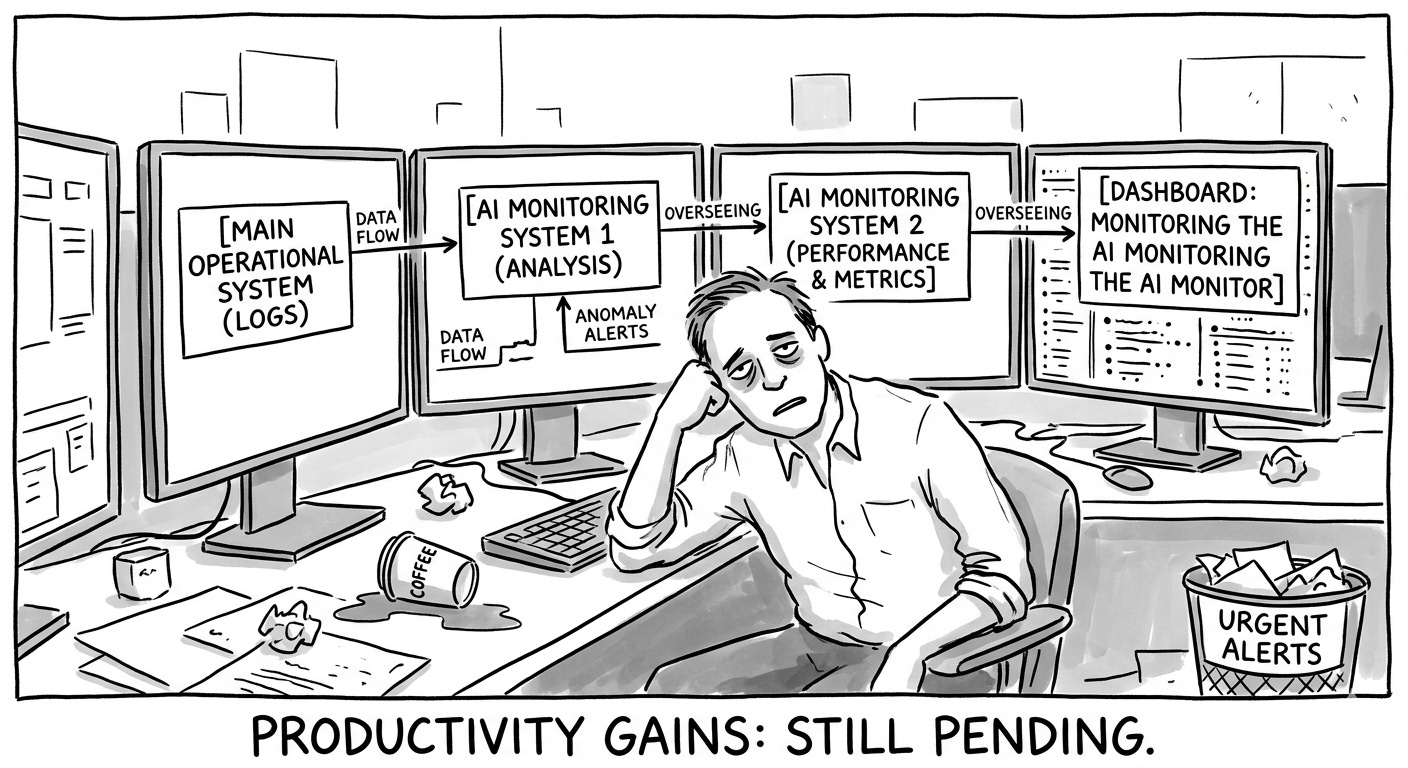
When AI automates tasks inside a job rather than the job itself, what remains is the supervisory overhead: monitoring, checking, validating AI outputs. This is what Orie calls the Residual Task Problem — a configuration that is cognitively fragile by design.
The reason is straightforward. Hackman and Oldham established in the 1970s that three task characteristics reliably predict engagement: skill variety, task significance, and autonomy. Monitoring an AI’s outputs scores poorly on all three. The work is thin, the contribution is invisible, and the margin for individual judgement is narrow. The brain does not avoid effort; it avoids wasted effort. Removing the meaningful tasks while retaining the supervisory residual is precisely the wrong configuration.
This is the more common experience. But it is not the most dangerous one.
Brain Fry
A BCG study of 1,488 workers, published in HBR in March 2026 (Bedard, Kropp, Hsu et al.), found that AI oversight is the most mentally taxing form of AI engagement — more taxing than using AI collaboratively or as a tool. High oversight predicts 14% more mental effort, 12% more mental fatigue, and 19% more information overload. Workers who hit full Brain Fry — 14% of the sample — experience 33% more decision fatigue, 39% more major errors, and a 39% higher intent to quit.
The asymmetry is what matters. AI replacing repetitive tasks predicts a 15% reduction in burnout. Delegation and supervision are not the same cognitive operation. Organisations deploying AI at scale and measuring engagement without distinguishing which kind of AI interaction people are having are systematically misreading their own data.
It is also not primarily a tooling problem. Brain Fry is predicted by oversight responsibility, not interface complexity. Better UX will not resolve it. The task configuration is load-bearing, not the tool design.
Why No One Is Fixing This
The structural diagnosis is uncomfortable. In most enterprises, job design sits in HR and job evaluation. Process design sits in Operations or Transformation. AI governance sits in IT or Legal. Work Design — the integrated practice of deciding who does what, in what configuration, with what oversight model — has no natural owner. The gap is structural, not attitudinal.
The invisible cost problem compounds this. Pereira, Graylin and Brynjolfsson, in their analysis of 51 successful AI deployments (The Enterprise AI Playbook, Stanford Digital Economy Lab), found that 77% of the hardest practitioner-identified challenges were invisible: change management, process redesign, data quality. The technology was consistently the easiest part. Crucially, 61% of those successful projects had at least one prior failed attempt whose costs never appeared in the successful project’s accounting.
The strongest counter to this diagnosis is that AI deployment itself surfaces redesign needs that would otherwise remain invisible — making deployment a discovery mechanism rather than redesign a precondition. The evidence complicates this reading: 61% of successful projects had a prior failed attempt. Discovering the redesign need through failure is not the same as designing from the outset. The costs were paid; they were just paid by the organisation that failed, not the one that eventually succeeded.

The J-curve that Issue #50 described stays flat not because AI is weak, but because the complementary investments — chiefly, redesigning the work itself — are deferred.
This is precisely what I am driving at Campari. Across the several dozen AI use cases we are experimenting with in HR, we adopted a design principle from the start: every use case must be designed together with the job holder of today, so that work considerations are built in from the outset. We are working on this in multiple ways; the most interesting is “Gioia for HR” — a pilot HRBP digital twin where HRBPs from across the organisation are collectively building the institutional context the tool needs to work well. You could argue that it is easier to do this within HR. For me, it is vital to pilot this inside HR precisely to prove the principle where I have full accountability before it can scale elsewhere. The results are telling: Work Design requires cross-functional thinking, closer integration between HR and technology, and deliberate routines for sharing learning across organisational boundaries. And you arrive at the same conclusion: work design is the missing piece.
What Intentional Work Design Looks Like
The governance signals are accumulating. Tobi Lütke’s April 2025 mandate at Shopify — requiring teams to demonstrate why AI cannot do a job before requesting headcount — is a blunt instrument. But it is a Work Design instrument: it reframes every role design question as an automation boundary question.
Microsoft’s Camp AIR, reported by Spataro in May 2026, is the more operational model: two weeks of protected redesign time before enabling Copilot agents. “Redesign first. Then AI just works.” treats redesign as infrastructure, not overhead.
The empirical case is sharper. Across those same 51 deployments, organisations using escalation models — where humans review AI-flagged exceptions rather than approving each output — achieved 71% productivity gains. Approval models achieved 30%. The oversight model is the highest-leverage Work Design choice available in an AI deployment, and it is routinely left undesigned. This is not a claim that every organisation should use escalation logic — context, risk level, and task type all affect the right configuration. It is a claim that not deciding is itself a decision, and usually the costliest one.
The clearest operational illustration is IKEA. When its Billy AI automated 57% of routine customer support conversations, IKEA did not reduce headcount. It analysed what the remaining 43% of interactions required, found they were advisory — customers seeking spatial planning and home design guidance — and redeployed agents as interior design consultants. The redesigned function generated more than €1 billion in new global revenue. The cost centre became a profit centre. None of this happened automatically. It required a deliberate decision about what the elevated human layer should do.
The Load-Bearing Piece
Work Design has always been load-bearing — it is the mechanism, as Issue #35 set out, through which an organisation’s productivity coefficient is actually set. What has changed is the cost of ignoring it. When AI handles the routine and leaves humans with the residual, the absence of design is immediately felt: in the fatigue numbers, the error rate, the quit intent.
The useful framework here is the elevation space: as AI compresses the routine substrate of a role, it simultaneously expands the layer of contextual judgement, exception handling, and institutional accountability that humans must fill. The Residual Task and Brain Fry are both symptoms of organisations that have let AI compress the substrate without deliberately designing into the elevation space.
The practical unit for that design work is the skill — a bundle of related tasks with a coherent capability, small enough to redesign and large enough to govern. At the skill level, you can decide what AI augments, what it replaces, what oversight model applies, and who is accountable for the quality of that configuration.

Issue #51 named the governance gap. This issue makes it human. The distance between AI deployment and J-curve payoff is not filled by technology confidence, training programmes, or better tools. It is filled by the intentional redesign of work — and that requires someone to own it.
What do you think?
Sergio
2. Site Updates
I wrote a new Essay : Organisational Grammar: The Atomic Elements of Designed Coordination — introduces the six atomic elements (Role, Skill, Group, Decision, Obligation, Accountability) as the underlying vocabulary of any organisation design work. If this issue’s argument — that the skill is the right unit for Work Design decisions — resonates, the Grammar piece is the structural companion.
The Laws of Organisation Design series continues on the blog: the Law of Requisite Variety and the Law of Alignment are both up. The Laws series is the slower, more structural companion to this newsletter’s arc.
3. Reading Suggestions
When Using AI Leads to Brain Fry — Bedard, Kropp, Hsu et al. (BCG / HBR, March 2026) The primary research behind this issue. 1,488 workers, three types of AI engagement. The oversight configuration data is the most actionable finding for anyone currently deploying AI at scale — the asymmetry between replacement and supervision is not intuitive, and the quit-intent numbers are striking.
The Residual Task Problem — Nico Orie (LinkedIn) Short, sharp, and immediately applicable. The framing that set me thinking for this issue. Worth three minutes.
The Enterprise AI Playbook — Pereira, Graylin & Brynjolfsson (Stanford Digital Economy Lab) 51 successful AI deployments, analysed for what actually made them work. The 61% prior-failure statistic is buried in most write-ups; the escalation/approval productivity split rarely gets the attention it deserves.
Redesign First. Then AI Just Works. — Jonathan Spataro, Microsoft WorkLab (May 2026) The Camp AIR account from the inside. The clearest practitioner case for Work Design treated as a governance decision rather than an afterthought.
4. The (un) Intentional Organisation 😁
5. Keeping in Touch
Don’t hesitate to reach out by directly hitting “reply” to this newsletter or using my blog’s contact form.
I welcome any feedback on this newsletter and the content of my articles.
Find me also on: