



1. It’s the Design, Baby
Last time I closed with a promise: to go underneath the question of who holds the pen when work is redesigned, to the mechanism. What happens to a function that answers for an outcome it had no hand in designing, and why does everybody end up calling the result resistance?
You know the behaviour, because every organisation has it. A project arrives at Legal, at HR, at Risk or at Compliance, and it stops there. The function asks for more information, then for a sign-off step, then for a committee. The project team escalates. And at some point somebody says the sentence: the problem is the culture of that function. The prescription follows naturally. More engagement, an awareness campaign, a sponsor who explains why the change matters. Persuasion, in other words.
I have been on both sides of that sentence, and I think the diagnosis is wrong. But it is a good alibi to hold, because locating the issue in change resistance moves the observation away from how the change was designed.
Let me give you an example. Some years ago I was involved in the redesign of a “direct to consumer” organisation. Everything seemed to have aligned. The formal strategy of the organisation had given “DTC” a firm seat in the strategic priorities. Every piece of technology that read “omnichannel” was bought. Agile teams set up to “listen” to internal customers for the redesign of processes. Six months in, the metrics chosen for this DTC success were, however, not moving. “Change Resistance” was the diagnosis of the consultancy in charge, with the usual change management proposal in place. “Retail Culture” was the internal story, from the advanced technology to the old brick and mortar guys who could not adapt to the new world. The issue was a lot more basic. Store staff was much more in tune to everything digital than any of the HQ people. The project had focused on the commercial enablers, but had not touched the rest. So, returning something in store that was bought online still implied 12 separate steps in 3 systems, and only for a voucher everything else was “impossible”. Choosing an item in store and getting it delivered home from the online store was possible only within the country, and the sale was not recognised to the store, but to the online channel.
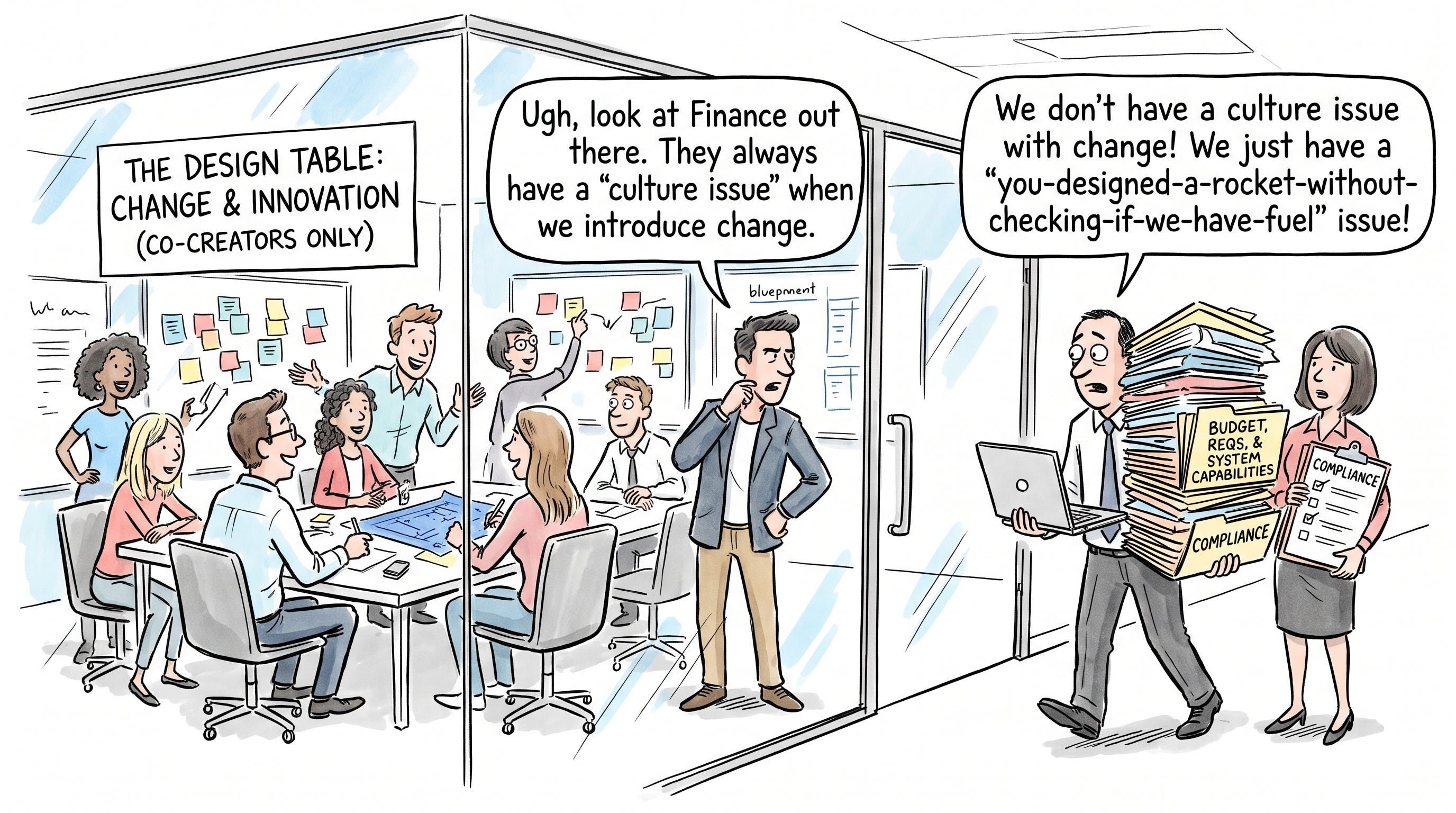
Most of the above became “finance’s fault”. When the project finally asked for store sales to be credited back to the stores, finance said no: the company had always reported revenue by channel, and investors expected it that way. The typical functional resistance to change, everyone concluded. But nobody had asked finance into the design of the programme. It was answerable for how revenue is reported, it had a veto, and it used it. Asked at the start, the same people could probably have designed a way to credit the stores without touching what investors see.
What the evidence actually says
In Issue 54 I used the Stanford Digital Economy Lab’s study of 51 successful enterprise AI deployments. Staff functions (Legal, HR, Risk, Compliance) were the most frequent source of resistance, at 35%, ahead of end users at 23%. I went back to the report for this issue, and I owe you a correction: I read it more cleanly than it reads. The 35% is a frequency, in a sample the authors chose because the deployments succeeded. And the fix is not one lever. The authors’ own phrase is “mandates, not persuasion”, and the mandates are of two kinds. Where adoption counted in the corporate OKRs and the staff functions no longer had to carry the blame for a failure, they found ways to enable. Where they were given a part in governing the deployment instead of being asked to approve it, they often moved from blocking to supporting.
Read this way, the evidence is weaker as proof and stronger as a clue. Both levers are design moves. One takes the accountability away from the function; the other gives the function a decision. Nobody in the report fixed it with a better change narrative.
Who holds the veto, and who holds the pen
There is one more line in the report that I passed over the first time. These functions, the authors note, have the organisational authority to slow down or stop a project, whatever the executive sponsor wants. So they are not powerless. They hold a decision. It is just a particular kind of decision.
Eugene Fama and Michael Jensen made the distinction precise more than forty years ago, when they broke every decision process into four steps and grouped them in two.
Decision management is initiating a proposal and implementing it: the pen.
Decision control is ratifying it and monitoring it: the veto.
Many staff functions are handed the second and judged as if they held the first. They answer for the outcome (the fine, the lawsuit, the discrimination claim, the data breach) but the design of what produces it was drawn elsewhere, and reaches them at the end, for approval. A function in that position has exactly one instrument that reduces its exposure, and it uses it. Which is what drives the perception of staff functions always as “nay agents” and “change blockers” rather than supporters and enablers.
This is not a new finding, only one HR rarely reads. Philip Tetlock and Barbara Mellers, surveying decades of accountability research, report a warning worth taking seriously: holding people answerable for outcomes outside their control can produce risk-averse herding and, at the extreme, people hoarding information from each other. Christopher Hood spent a book on the blame game in government and found blame avoidance built into the architecture of organisations and the shape of their standard routines, to the point where procedures seem designed so that nobody is responsible for anything. None of it is a cultural trait. It is what a rational actor does when the consequence is theirs and the choice is not.
Culture problem? Wrong. It is a design problem, and the organisation designed it.
Accountable, responsible, and the words we use
In Issue 60 I promised an issue on the difference between being accountable and being responsible. Here it is, though not quite in the terms I expected.
The words themselves are not much help. Responsible comes from the Latin respondere, to answer, to promise in return; accountable from the Old French aconter, to reckon up and render the account. At the root, both mean answering. The difference we draw between them is not in the words: it is in the way we have chosen to organise.
The everyday vocabulary comes from RACI, where the Responsible party does the work and the Accountable party answers for it and, in most versions, signs it off. Notice what that does. It fuses answering for an outcome with approving it, and leaves out the design entirely. The matrix records the veto and calls it ownership.
As I explored the basic components of organisations in the Organisational Grammar I kept apart three things that RACI blurs.
Accountability is the assignment of answering for an outcome.
Decision is the commitment to a course of action that produces it.
Authority is not an element at all: it lives in Governance, as the right to make certain Decisions, and to create or dissolve the elements that carry them.
Responsibility, in the RACI sense, is mostly a question of Role: who performs the work. The misalignment that matters is between the other two. And design authority, a phrase I have used freely in this newsletter without defining it, finally gets a definition: it is the Governance right over the Decisions that produce the outcome you answer for.
Put it next to Issue 60’s three conditions for ownership (you answer for the result, you can change how the work is done, you can narrow it or stop it) and the staff function’s position becomes very clear. It holds the first. It holds a distorted version of the third, because it can stop the work but not end it. It does not hold the second.
Accountability plus a veto, minus the design, is the exact geometry of defensive behaviour.
Two moves, and neither is persuasion
Michael Jensen and William Meckling described the underlying problem as one of bringing knowledge and decision rights together: either the decision moves to whoever has the knowledge, or the knowledge travels to whoever holds the decision. The same two moves hold for accountability.
Move the Decision to the Accountability. Give the function the pen at the start, not the stamp at the end. Privacy by design is the institutional version of this: the people who answer for privacy are inside the design of the system before it exists, not reviewing it after. That is a different job, and it needs different skills.
Move the Accountability to the Decision. If the design stays with the business, so does the answer for it, and the staff function becomes an adviser whose advice is on record. This is the other lever in the Stanford report: where the staff functions no longer carried the blame for a failure, they found ways to enable.
What is not on the list: an awareness campaign, a training programme, a sponsor who explains the vision once more. They may help. They do not change the position, so they do not change the behaviour.
By the way, the above is part of the intuition of the concept of business partnering. As a staff function I need to sit at the tables where the original design decisions are taken so that I can have a word. Very positive intent, but in most cases it gave staff functions a seat, not a pen: a voice without a vote, the Consulted of RACI. Which is why the result has often been a plethora of job titles that amplified a siloed idea of holding back implementation, rather than curing it.
Where it should not apply
There is a strong objection, and it deserves to be stated properly. Sometimes accountability without design authority is exactly what we want. An auditor must not audit the controls it designed; the Institute of Internal Auditors builds the independence of the third line on precisely that separation, and Fama and Jensen themselves showed why separating management from control is efficient in large, complex organisations.
So the mechanism needs a boundary, and I think it is this. It applies to functions that answer for the outcome. It does not apply to functions that answer for independent assurance of the outcome. The trouble starts when a function is designed as an owner and slides into the auditor’s chair because the chair is safer: it keeps the veto, gives up the pen, and still gets the blame when something goes wrong. Last time I argued that HR should ask for a role in governing the redesign of work rather than in approving its outcomes. This is why.
A test you can run on Monday
Take any outcome a function in your organisation is held accountable for, and ask three questions.
Which decision actually produces it?
Who holds that decision today?
Who can change the rule that places it there?
If the three answers point to three different places, and the function was never meant to be independent, you have built a veto without a pen. Expect it to be used.
Run it on the DTC programme. The decision that produced the store experience was how sales were credited. Finance held it. Nobody in the project could change the rule. Three answers, three places.
This is the function level. Next time I want to ask the same question one level down, of a single person: when someone builds their own AI agent to do part of their work, what do they actually hold, and what can the organisation claim?
In the meantime, a question. Think of the last time a staff function blocked something you cared about. What was it answerable for, and when did it first see the design?
Sergio
References
Fama, E. F., & Jensen, M. C. (1983). Separation of ownership and control. Journal of Law and Economics, 26(2), 301–325. https://doi.org/10.1086/467037
Hood, C. (2011). The Blame Game: Spin, Bureaucracy, and Self-Preservation in Government. Princeton University Press.
Institute of Internal Auditors (2020). The IIA’s Three Lines Model: An update of the Three Lines of Defense(updated September 2024).
Jensen, M. C., & Meckling, W. H. (1992). Specific and general knowledge, and organizational structure. In L. Werin & H. Wijkander (Eds.), Contract Economics (pp. 251–274). Blackwell.
Pereira, E., Graylin, A. W., & Brynjolfsson, E. (2026). The Enterprise AI Playbook: Lessons from 51 Successful Deployments. Stanford Digital Economy Lab.
Tetlock, P. E., & Mellers, B. A. (2011). Structuring accountability systems in organizations: Key trade-offs and critical unknowns. In National Research Council, Intelligence Analysis: Behavioral and Social Scientific Foundations (pp. 249–270). National Academies Press. https://doi.org/10.17226/13062
2. Newsletter & Site Updates
If this email looks different, it is not your inbox. The intentional organisation newsletter has a new design! New logo, new color scheme, new layout on the landing page. As I worked through my web presence, I tried to differentiate the newsletter from my website also graphically.

Talking of the website: this fortnight the website moved more than the newsletter did. And since this issue is about who holds the pen, let me run the test on my own site. There I hold both: I write every page and I approve every page, while the agents only propose. Which is probably why it has changed twice in two months. The full list is here; here the key additions.
Two living pages. AI and Work and AI and Talent are not articles but running syntheses of what this newsletter has argued since Issue 49, updated every week as the evidence stacks up. One asks who holds the judgement once AI takes the tasks; the other, who designs development once the work that produced it is gone. If you joined halfway through the thread, start there.
Bayer, read twice. Bayer came up at Zing in the last issue; now it has two pages as part of my items collection. Dynamic Shared Ownership joins the operating models and VACC the leadership collection, together with Nanus’s Visionary Leadership, for 158 leadership models in all. My verdict on DSO fits this issue rather too well: it shares the decisions, not the ownership its name promises.
You can listen now. Some articles read themselves aloud, in my voice, rendered by AI, starting with the key pieces as I revise them, such as the Organisational Grammar.
Better maps. A redesigned Topics page, better search, and every collection diagram redrawn, now enlargeable and downloadable.
The bill. A site that runs on agents and audio has a footprint. What it costs, and what I do about it, is on the Sustainability page.
3. Reading Suggestions
The AI Financial Soufflé May Collapse. The Real Opportunity Is Just Beginning. — Stuart Winter-Tear, Unhyped AI, on Substack. His manager, who spent fifteen years building a department and is now asked to be enthusiastic about dismantling it, is the middle-manager version of this issue: people respond to the organisation built around them, not to the adoption course.
The Dangerous Comfort of Making Yesterday Faster — Brian Solis, A Quantum of Solis. Mostly about innovation, but one of his closing questions belongs on every risk committee’s agenda: where are we calling something high risk when it is really just hard to change?
Dashboards without decisions — Andrew Marritt, Working Ideas. People analytics rather than governance, but the same discipline: name the decision a display serves, how often it is made and who acts, or do not build it. A good companion to the test above.
The Polymorphic Organisation, Episode XLII — Perry Timms. An “anti-methodology” that is generous with its sources, and that names this issue’s risk in passing: empowerment can turn into responsibility without authority.
The impact of chief diversity officers on diverse faculty hiring — Steven Bradley, James Garven, Wilson Law and James West, Southern Economic Journal, 89(1), 3–36, 2022. The scientific pick. Across U.S. universities between 2001 and 2019, appointing an executive-level chief diversity officer had no statistically significant effect on diverse faculty hiring. Read it next to this issue: a role made answerable for an outcome is not yet a role that can change how the outcome is produced.
4. The (un) Intentional Organisation 😁
5. Keeping in Touch
Don’t hesitate to reach out by directly hitting “reply” to this newsletter or using my blog’s contact form.
I welcome any feedback on this newsletter and the content of my articles.
Find me also on: