



1. The Operating Model HR Built for Itself
There is a specific kind of structural problem that only becomes visible in reverse. You look at a design and ask: what was this actually for? And suddenly the solution is obvious — and so is the fact that the problem it solved no longer exists.
That is where HR stands with the Ulrich model.
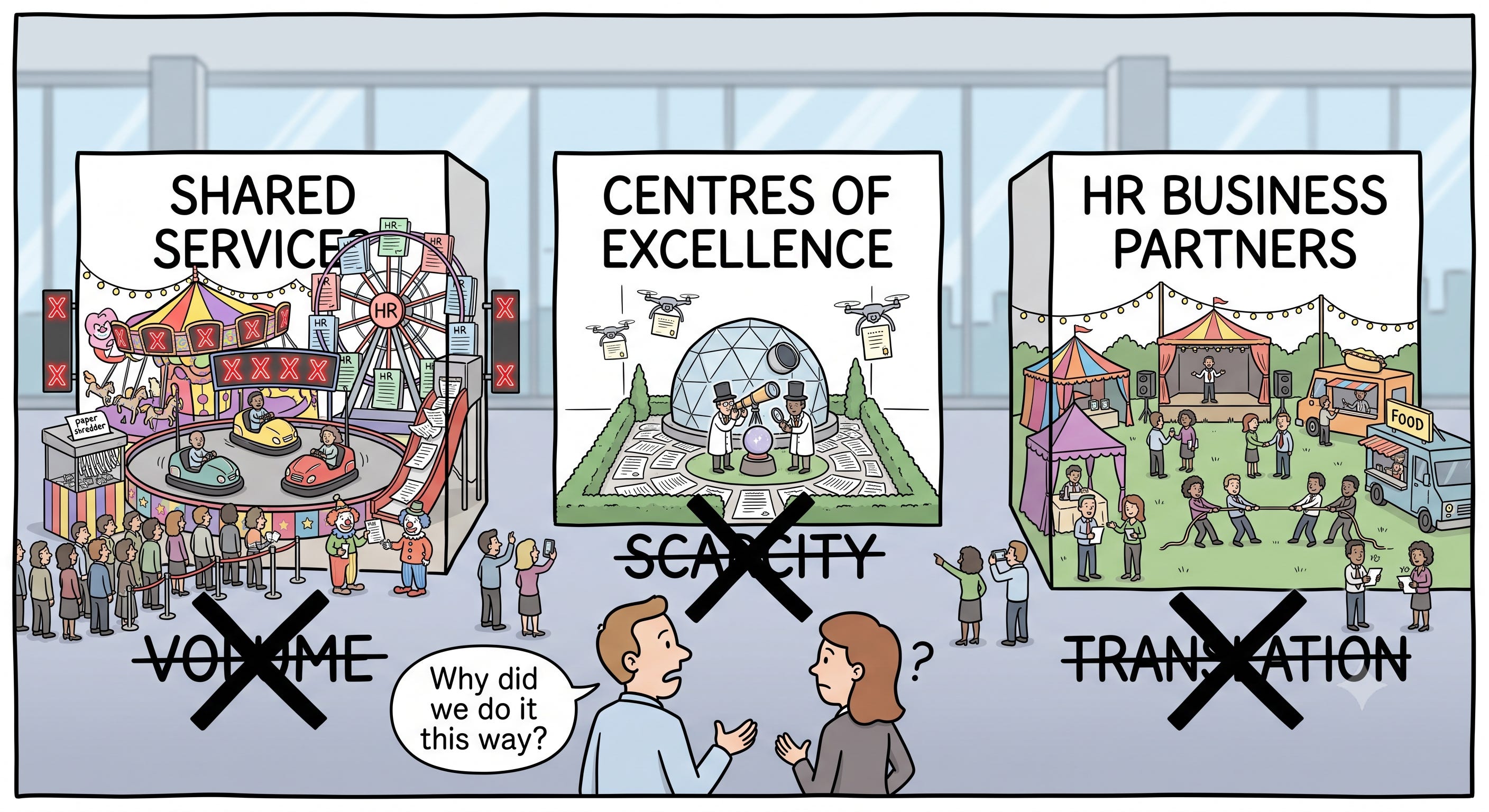
Dave Ulrich did not invent the three-box structure in 1997 out of bureaucratic instinct. He named what was already emerging because specific structural problems demanded specific structural answers. Shared Services existed to pool transaction volume — the administrative work of HR was too costly to distribute across every business unit. Centres of Excellence existed to concentrate specialist knowledge — expertise in reward design, learning architecture, or employee relations was too scarce to replicate locally. HR Business Partners existed as a translation layer — because neither of the other two boxes could reach the business without someone who understood both languages.
These were real solutions to real problems. The CIPD’s 2024 research confirms the model remains by far the most widely adopted operating model within HR. But the same report quietly notes what practitioners have been feeling for years: HRBPs often lack the time or skills for what is actually being asked of them; COEs become inflexible silos that respond too slowly. The structural strain was already there before AI arrived.
AI did not break the Ulrich model. It dissolved the conditions that made it necessary.
The volume argument is gone. AI agents handle tier-1 HR transactions — policy queries, leave requests, basic onboarding guidance — at near-zero marginal cost. The administrative work that justified pooling in Shared Services is increasingly the work that agents do without sleeping.
The scarcity argument is gone. When specialist knowledge can be embedded in a model and accessed by anyone with a prompt, the rarity of expertise no longer justifies concentration in a Centre of Excellence. What the COE was protecting — analytical depth, domain knowledge, the ability to see patterns across the organisation — is precisely what AI augments most aggressively.
The translation argument is going. AI-powered self-service is not augmenting the HR Business Partner — it is bypassing them. Managers who can query workforce analytics directly, generate first-draft job evaluations, or access policy guidance through a conversational interface have less need for a human intermediary. The HRBP was never just a relationship role. It was an information asymmetry role. That asymmetry is collapsing.
Three arguments, three boxes. The arguments are dissolving. The boxes remain.
The uncomfortable question
Here is what makes this hard. The function that is most needed to lead the redesign of its own operating model is also, empirically, one of its most consistent resistors. Pereira, Graylin and Brynjolfsson’s analysis of 51 enterprise AI deployments found:
Staff functions — Legal, HR, Risk, Compliance — were the primary source of institutional resistance in 35% of cases, ahead of frontline workers fearing replacement and ahead of end users generally (23%).
Wrong. HR is not resistant because it is backwards.
HR’s incentive architecture produces risk aversion as a rational outcome: avoid regulatory exposure, manage reputational risk, protect the function’s liability position. When an algorithm makes a hiring decision or a compensation recommendation, HR carries the accountability — and the legal exposure — for that decision. Risk aversion is not a cultural failure. It is a structural response to a structural incentive.
The governance reframe is the resolution. In the deployments where staff functions shifted from blocking to actively supporting AI adoption, the mechanism was the same: give Legal and HR a role in designing governance rather than a role in approving outcomes. Accountability with design authority produces different behaviour than accountability without it.
Which raises a question the CHRO has to hold simultaneously: you are the client of this redesign and the one who must lead it. The redesign of the HR operating model has to include a redesign of HR’s own governance reflexes — not just its org chart.
Marianne Roux frames the sharpest version of the objection: the HR function must reinvent itself before it can reinvent the organisation. She is largely right — and much of what she calls for, HR reorganising around outcomes and challenges rather than processes, is the same direction I am pointing. Where I part company is the word before. “Itself first” assumes a clock HR controls. It does not: the structural logic is dissolving from the outside in whether or not HR has put its own house in order. The question was never whether to reinvent before leading. It is how to hold both at the same time.

What the consulting mainstream has not yet said
The field has produced plenty of responses to the dissolution of the Ulrich model. Bersin’s “full-stack HR leader” is the most prominent: a strategic generalist who oversees talent advisory, AI orchestration, culture, and organisation design as the transactional layer automates away. It is a compelling image. But it is an optimisation of the current architecture rather than a redesign of its logic.
The Mercer Target Interaction Model lands in a similar place. Thoughtful, carefully evidenced — and still, fundamentally, the Ulrich model with updated role names.
Perry Timms offers something more structurally honest. His concept of the Polymorphic Organisation is built on a specific observation: most transformation programmes fail because they force a choice between legacy and future modalities, when what organisations actually need is to hold both simultaneously — in what he calls organisational oscillation. The critical implication for HR is where he locates the powerhouse of this oscillation: not in leadership, not in technology, but in OD — Organisation Design, Development and Effectiveness. Whoever holds that brief with genuine authority is the one who can navigate the oscillation rather than be consumed by it.
And we’re seeing this every day: more and more non-HR practitioners are writing about AI being not a technology adoption issue, but rather an Organisation Design challenge.
The fair orchestration of human development into intentionally designed organisational settings is what is needed to fill the gap.
That is the question the dissolution of the Ulrich model is actually asking. Not: what do we put in the boxes instead? But: who is accountable for the design logic itself?
Three questions worth sitting with
The field does not yet have a convincing answer to what replaces the three-box model at scale. I have been in enough rooms where this conversation happens to say that plainly. What I am more confident about is the shape of the questions that will determine the answer.
What decisions about people genuinely require human judgement that cannot be encoded — and how does the operating model make sure those decisions actually get made by a human?
Where does the business need a person in the room — not because the person knows more than the system, but because accountability requires a human face?
What does HR owe employees that a well-calibrated algorithm, however accurate, cannot give them?
These are not HR questions. They are design questions. Which is the point.
What do you think?
Sergio
References
CIPD (2024). Do Current HR Operating Models Serve Future Needs? Chartered Institute of Personnel and Development.
Pereira, E., Graylin, A. W., & Brynjolfsson, E. (2026). The Enterprise AI Playbook: Lessons from 51 Successful Deployments. Stanford Digital Economy Lab.
Ulrich, D. (1997). Human Resource Champions: The Next Agenda for Adding Value and Delivering Results.Harvard Business School Press.
2. Site Updates
I’m currently working on a revision of my site structure, particularly reviewing some its key content items. Stay tuned for a full refresh, which I hope will be available in a few weeks.
You can however watch myself in the last “Work Matters” podcast by Thomas Bertels .
3. Reading Suggestions
Decision Architecture: Why Organizational Speed Is Designed, Not Demanded, by Hassan Tirmizi | Linkedin — A really interesting take on Decision Debt and the fact that Speed in organisation design cannot be earned if not taken into consideration in design.
Designing the Future-Ready HR Function by Perry Timms | Kogan Page — a solid point of view on the need to focus on operating model design.
Defining a Complex System by David Snowden | The Cyncefin Co — After many years defining what a Complex System means, Dave Snowden experiments a definition of what it actually means.
How AI Is Reshaping Workflows and Redefining Jobs — Kristin Burnham, MIT Sloan. The clearest statement of the point underneath this whole issue: AI acts on workflows, not tasks, so the unit that has to be redesigned is the operating model, not the tool.
Designing the Future-Ready HR Function — Kogan Page. Treats HR as an engineering function that designs how work and decisions flow — the same move from organising around types of work to organising around the design logic itself.
Ten Reasons Why We Won’t See Productivity Improvements from GenAI by Tom Davenport — A useful cold shower: the gains do not arrive until the work is redesigned, which is exactly why bolting AI onto the three-box model changes so little.
Ford Has Been Rehiring Quality Inspectors After AI Fell Short — Keith Naughton, Bloomberg. A concrete answer to this issue’s closing question about where a human still has to be in the room: the judgement that could not be encoded had to be rehired.
4. The (un) Intentional Organisation 😁
5. Keeping in Touch
Don’t hesitate to reach out by directly hitting “reply” to this newsletter or using my blog’s contact form.
I welcome any feedback on this newsletter and the content of my articles.
Find me also on:
We don’t need to reinvent HR because AI has arrived. We need to reinvent HR because many of the assumptions that shaped the profession no longer match how value is created. The real question isn’t whether HR should lead AI. It’s whether HR is prepared to re-examine its own foundations, I.e. job architecture, governance, hierarchy, careers, performance, and capability or whether it will continue trying to build adaptive organisations on structures designed for a different era.