



1. Designed by Default
Last time I closed with a promise: to turn the task fallacy on the function that, in most organisations, should be best placed to see work systems and is mostly equipped to see jobs. I would like to keep it starting from a number, because this function has been told a lot of numbers this year.
In January Josh Bersin published The Great Reinvention of Human Resources Has Begun. The headline: “30-40% of existing HR ‘jobs’ can be automated with relatively low effort”, and the ratio of employees to HR staff, historically “around 100:1”, could reach 200:1, 300:1 “or even 400:1”. The figure came from querying Galileo, his company’s own HR agent, over task-level data on some 250 HR jobs. No sample, no method, no definition of “relatively low effort”. In August the same percentage came back describing something else: the share of HR jobs that are administrative titles, which, he now wrote, “are NOT GOING AWAY”. His own data in the same piece show HR job postings still growing, by about 1.2% a year, and HR pay rising faster than inflation.
I don’t write this to score a point. I have read Bersin since before I joined Deloitte and he is often early on the right question. But the independent measures sit an order of magnitude below the headline: SHRM finds 7% of organisations reporting job displacement in HR against 39% reporting shifts in responsibilities, and Gartner’s 2024 Hype Cycle for HR technology predicts that even where employees complete 90% of HR tasks through a conversational interface, HR headcount falls by less than 5% by 2028. What changes is the work inside the roles, much more than the number of roles.
Notice what the two versions of the number have in common, though. Both count. The first counts tasks that can go, the second counts titles that will stay. It is the task fallacy, applied by HR to itself. And it answers a question that was never the interesting one. In Issue 54 I argued that the three arguments behind the HR operating model, volume, scarcity and translation, are being dissolved by AI; I won’t go back over that here. The question I want to ask starts after it. Not how many HR jobs AI can take, but who decides how work is redesigned when it does.
Who is holding the pen?
The evidence is surprisingly one-sided. SHRM reports that 52% of organisations do not involve HR in their AI strategy at all. Asked who has the most influence on AI decisions, the more than 170 C-suite executives in a Beamery survey named the CEO (81%), then the digital, transformation or automation chiefs (50%)… and the CHRO, at 12%. Gartner describes work reengineering happening “opportunistically in pockets… without an enterprisewide strategy or direct HR involvement”. And AIHR’s summary of the year is the most precise of all: HR owns more outcomes than decisions, asked to reskill people only after the technology, the investment and the automation targets have already been set.
Bertrand Duperrin put it in a sentence I have not been able to stop thinking about:
Once we’re no longer just talking about creating content but about eliminating tasks or revising processes, we move beyond the scope of HR alone and into the realm of work, and that realm belongs to no one.
This translates into a very concrete picture. HR recruits, IT provides the tools, operations designs the processes, managers organise the day. Each of them redesigns its piece of the work, and the work as a whole, the flow between the pieces, is redesigned by default. Which is exactly the condition Issue 61 described: a decision nobody takes.
Why HR cannot see it
So why is the function that should care most about how work is organised not the one holding the pen? Part of the answer is power, and the numbers above show it. But part of it is that HR was built to design something else. Let’s see why.
The literature itself is not consistent on the words, so let me be precise.
Job design is the arrangement of tasks, responsibilities and conditions inside a role: what the job description, the grade and the evaluation describe. It is what HR’s instruments were built for, and as I argued in Issue 53, they are very good at it.
Work design is, in Morgeson and Humphrey’s definition, about the composition, content, structure and environment “within which jobs and roles are enacted“. The flow of tasks, information and decisions across roles, teams and now agents.
Many people use the two terms as synonyms, including some of the best scholars in the field. Sharon Parker chose to drop “job design” for “work design” precisely because the fixed job had become too narrow a unit. My own reading, from theory and experience, goes one step further. Job design is work design applied to only one discourse of work, the one in which work has been packaged into the Job. It works well inside a function’s process map, and it stops at the function’s edge. Most HR functions are excellent at the first. Almost none have been asked to do the second.
We already have the case.
At a large consumer-goods group, a multi-year integrated-planning programme spent heavily on systems, tools and new planning roles. The design question nobody owned was simpler: in the local markets, commercial and finance did not plan together. The programme redesigned the jobs around the plan; it never redesigned the work between the two functions.
Every new role was well designed. The work was not.
When it works, the authority is borrowed
I have also seen the opposite. When I led a digital transformation programme at a global apparel group, we introduced Agile ways of working across teams on different continents. Planning the hand-offs between them, we had to accept that this was not a process to be mapped but a new way the work needed to be done. Traditional job design was not enough: what mattered was the flow of information, and an effectiveness built not on roles but on individual attitudes and team priorities. What made it possible was the mandate.
The cleanest public example I know points the same way. Moderna merged HR and IT into a single function under Tracey Franklin, to “architect the flow of work: how tasks, information and decisions get done”, moving from workforce planning to work planning. It is a remarkable move, and Franklin herself says it is “not a one-size-fits-all solution”. Look at where the authority came from in both cases, though. Not from HR’s standing in the organisation. From a transformation mandate in one case, and from absorbing IT in the other.
The uncomfortable part
Now the part that is less comfortable for my own profession. The exclusion is not only a matter of power. In a CIPD survey earlier this year, fewer than half of the 97 HR leaders asked, 46%, felt confident leading job redesign, and only 40% felt confident designing reskilling pathways. At the top of the function the picture is similar: Heidrick & Struggles finds that only one CHRO in four works at the enterprise scope CEOs now expect, while the number of skills CEOs look for in the role has grown by half in ten years. A function that does not trust itself to redesign jobs is not going to be handed the design of work.
The academic side has been saying something similar for a while. Sharon Parker and Gudela Grote’s review of work design in a digital world asked for work design choices to be considered proactively while a technology is implemented, not afterwards. Revisiting it two years later, they found the top-down work design perspective on digital technologies “even more important than ever yet still neglected”. That moment, during implementation, is the one HR is usually not in.
In Issue 60 I argued that the people function should be the steward of the organisation’s capabilities, not their owner, and only if it is redefined, not rebranded. Bain describes the operating model moving the same way: functions shifting from owning work to stewarding capability. This issue is, I think, what the redefinition has to contain. Three things, none of them a new box on the HR chart.
The map of work. Not the map of jobs and grades, but of flows: where the output goes next, who checks whom, what each step teaches. The work system of Issue 61, kept current.
The practice. The discipline of work design, done jointly with operations and technology, at the moment the technology arrives. Not a centre of expertise that reviews the design afterwards.
The mandate. A role in governing the redesign rather than in approving its outcomes. Issue 54 showed what changes in a staff function’s behaviour when it gets one.

Work belongs to no one today, in most organisations. That is not a vacancy HR can fill by asking for it, and not one it should fill by claiming ownership. It is a practice the function can choose to build, or leave to whoever happens to buy the next tool.
Next time I want to go underneath this, to the mechanism: what happens to a function that answers for an outcome it had no hand in designing, and why everybody ends up calling the result resistance.
In the meantime, a question. Think of the last AI deployment in your organisation that changed how work flows between two teams. Who decided the new design, and when was HR told?
Sergio
References
Beamery (2025, 18 November). Business Wire. https://www.businesswire.com/news/home/20251118133656/en/
CIPD (2026). How AI is changing the application of HR skills (L. Crowley). Chartered Institute of Personnel and Development. https://www.cipd.org/uk/views-and-insights/thought-leadership/insight/futureproofing-skills-ai/
Gartner (2024). Hype Cycle for HR Technology, 2024 (J. Freyermuth, G00811342). Gartner, Inc. https://www.gartner.com/en/documents/5633091 [paywalled]
Heidrick & Struggles (2026). Chief HR officer focus: What high-performing CEOs want from their CHROs (Kropp, Warga & Wilson). https://www.heidrick.com/en/insights/human-resources-officers/chief-hr-officer-focus_what-high-performing-ceos-want-from-their-chros
Morgeson, F. P., & Humphrey, S. E. (2008). Job and team design: Toward a more integrative conceptualization of work design. Research in Personnel and Human Resources Management, 27, 39–91. https://doi.org/10.1016/S0742-7301(08)27002-7 [definition read via Parker, Morgeson & Johns, 2017]
Parker, S. K. (2014). Beyond motivation: Job and work design for development, health, ambidexterity, and more. Annual Review of Psychology, 65, 661–691. https://doi.org/10.1146/annurev-psych-010213-115208
Parker, S. K., & Grote, G. (2022a). Automation, algorithms, and beyond: Why work design matters more than ever in a digital world. Applied Psychology, 71(4), 1171–1204. https://doi.org/10.1111/apps.12241
Parker, S. K., & Grote, G. (2022b). More than ‘more than ever’: Revisiting a work design and sociotechnical perspective on digital technologies. Applied Psychology, 71(4), 1215–1223. https://doi.org/10.1111/apps.12425
Parker, S. K., Morgeson, F. P., & Johns, G. (2017). One hundred years of work design research: Looking back and looking forward. Journal of Applied Psychology, 102(3), 403–420. https://doi.org/10.1037/apl0000106
SHRM (2026). State of AI in HR 2026. Society for Human Resource Management. https://www.shrm.org/executive-network/insights/state-of-ai-hr-2026-5-critical-insights-chros
2. Reading Suggestions
Starbucks’ CSO Shake-Up Raises Questions About Corporate Climate Commitments — Sandhya Sabapathy, Observer. An article on sustainability that reads like this issue with one word changed. The chief sustainability officer had “a voice without a vote” over the decisions that set a company’s footprint, and her test for any strategy is a good one for any function: would it survive if the person who championed it left tomorrow?
Building the semantic layer is no longer negotiable — Richard Rosenow, Ikona Analytics. Every HR team has a Rob: the payroll veteran who knows what a termination code really means. AI agents will not ask Rob, they will guess, so what sits in his head has to be written down and owned before it walks out of the door.
Ontology vs. Taxonomy vs. Knowledge Graph vs. Semantic Layer vs. Context Graph — Julia Díez, Build Local, Ship Global, on Substack. The Substack pick, and the clearest explanation I have read of five terms we use as if they were the same. Read it with your job architecture in mind: a taxonomy can only say what is a type of what, and most of the relations that matter in work are not of that kind.
Peter Block: relationships, resistance and the relevance of ‘Flawless Consulting’ — Messy Social Work, with Rich Devine and Tim Fisher. A listen rather than a read. Block’s idea that resistance is valuable information, not an obstacle to overcome, is the best way I know into the next issue.
Stubborn traditionalism in HRM: Causes and consequences — John Boudreau and Edward Lawler, Human Resource Management Review, 24(3), 232–244, 2014. The scientific pick. Years of survey data on how little HR’s role and use of time changed, and why the host organisation’s way of managing keeps it that way. Written well before AI, and it explains a good part of this issue.
3. Events
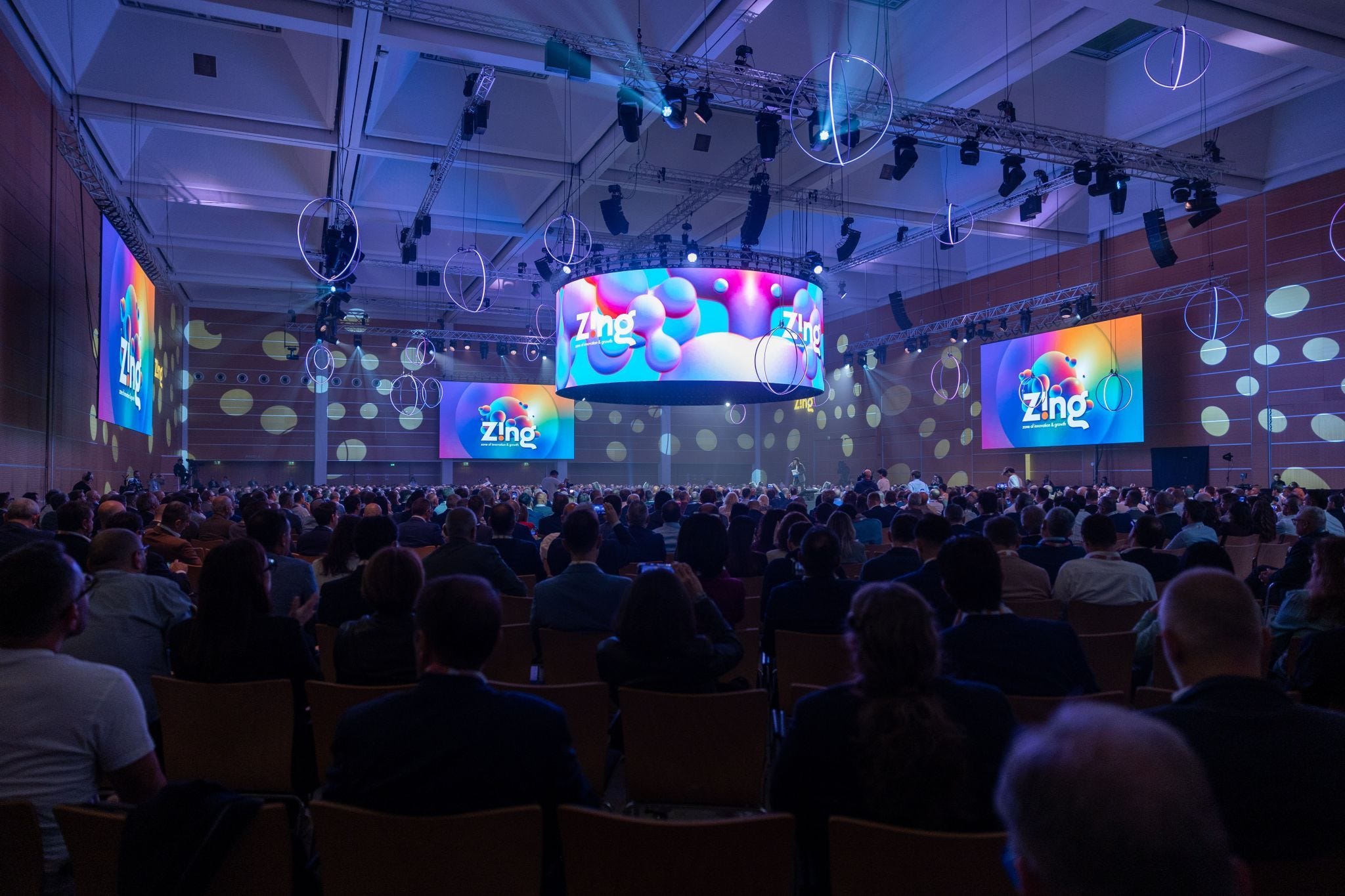
Last week I spent two days at Zing 2026, Var Group’s event in Rimini, and the theme was not one I expected from a technology company: turning polarities into action. Monica Maggioni drew the distinction that stayed with me. Polarisation forces you to pick a side, and destroys value on the way; a polarity holds two truths together, and that is where new energy comes from. Freedom and control, individual initiative and company goals: much of what organisations call a trade-off is a polarity they have decided to treat as a fight.
The braver choice was to give so much of the stage to the idea that organisations themselves need a revolution. Francesca Moriani, the group’s CEO, said she was happy no longer to do many of the things her role would require in a traditional hierarchy. Notice what kind of statement that is. Not delegation (my note from that moment, underlined: non è delega), but a decision about where decisions sit, taken by the one person who could take it. Read next to the essay above, it is the rare case where the design of work does belong to someone. Arianna Gregis, CEO of Bayer Italy, walked us through another large company putting “we have always done it this way” on trial, and David Marquet and Martin Lindstrom, from very different directions, landed on the same simple point: apply some common sense, and treat people in organisations as adults. Pim de Morree of Corporate Rebels closed the second day there too, because a world of work that is “broken” has to be fixed starting from that.
Common sense is a harder answer than it sounds, though. Every button on Lindstrom’s exploded remote control made perfect sense to the department that added it. Nonsense is rarely a failure of good sense; it is what accumulates when nobody owns the removal.
Treating people as adults is what Francesco Frugiuele and I tried to work on, in our small way, in an HR session that was surprisingly full. We talked about a world that is changing and about organisations that have to change with it, and I was glad that the room left believing change is possible, despite an almost “natural” resistance from power. The session was also the launch of People Leap, a community Maria Rosaria De Maio outlined with Demetrio Labate and Caterina Tosetto. We need, more and more, a real movement to mark the way.
Two more things I brought home. Bebe Vio on stage, with a story of genuine humanity and resilience: a person cannot choose an amputation, and she has built a life on what can be added. Organisations behave as if they could not choose their own shape either, though they can, and after that talk every alibi for not changing sounds thinner. And the provocation of Alessandro Rinaldi and the DMAV Social Art Ensemble, whose Corporate Porn threw back at us the absurdity of the superstructures, linguistic ones included, that we have built inside companies. It is not normal to feel bad at work. It is not normal to talk the way we do at work, either.
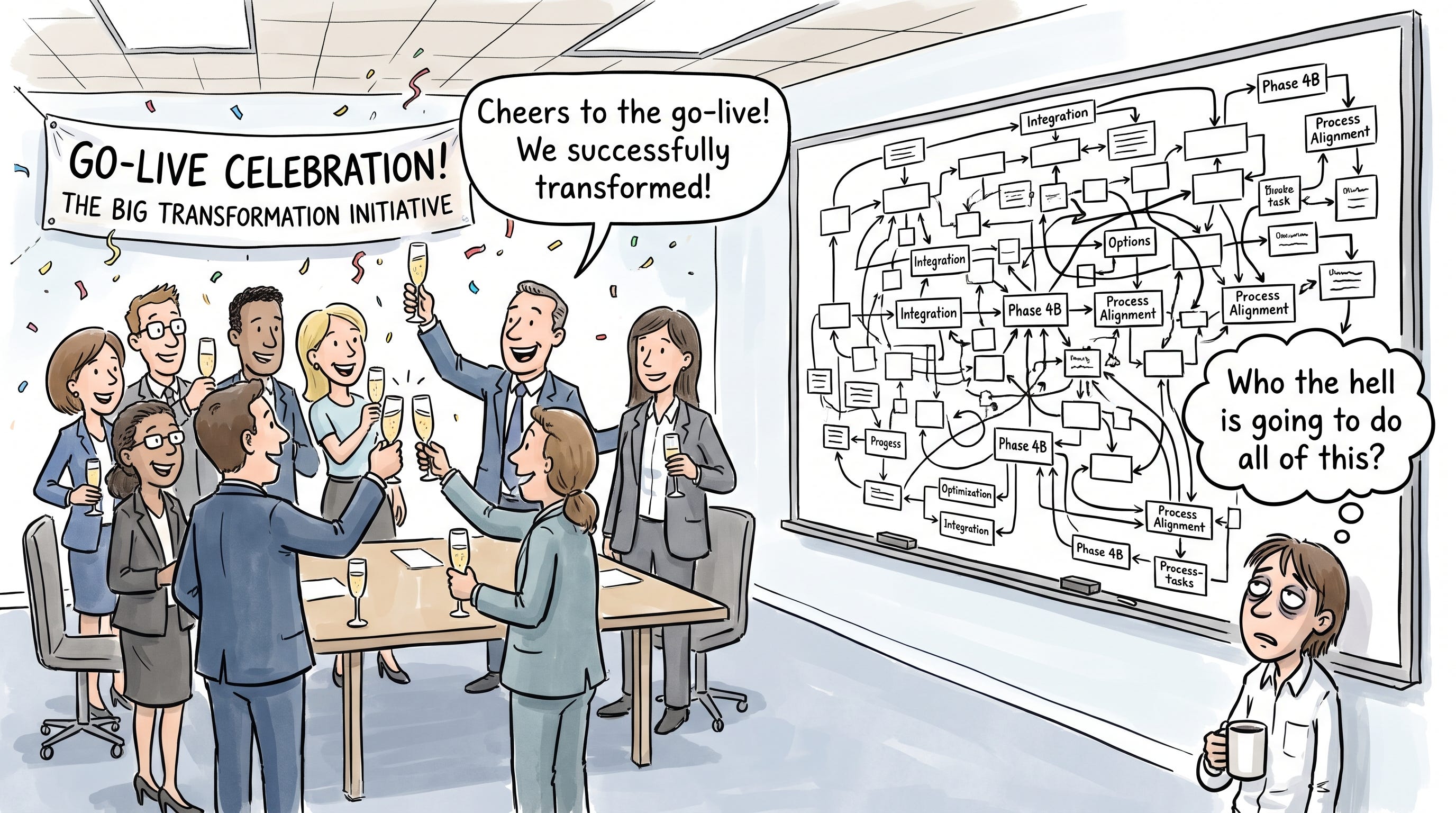
4. The (un) Intentional Organisation 😁
5. Keeping in Touch
Don’t hesitate to reach out by directly hitting “reply” to this newsletter or using my blog’s contact form.
I welcome any feedback on this newsletter and the content of my articles.
Find me also on: