



1. The Missing Junior Loop
Ben has been with the firm eighteen months. He is bright, he was well taught, and he wanted this job.
His work now consists of reading what an AI Agent produced and deciding whether it is right.
He is good at it, in the way you can be good at something in your second year at work: he catches the obvious errors, the ones where the output contradicts itself or the numbers do not add up. He does not catch the other kind. The wrong figure that sits in the third paragraph looking exactly like the eleven that are correct.
Nobody blames Ben. Everybody understands, without saying it, that there was no way he could have known.
(Ben is a composite person. But I have watched this pattern in enough organisations to be confident it matches the real experience of many)
Two issues ago I described an analyst whose craft was made of the slow, irritating, preparatory work that AI has now removed, and who was left checking outputs. Her name was Sarah, and several of you wrote to me about her.
Sarah checks against thirty years of knowing what wrong looks like. Ben checks against nothing.
In some organisations they have the same job title. They appear on the same dashboard, doing the same task, at the same rate, and the organisation cannot tell them apart on any instrument it owns. But it will find out the difference when Sarah retires. And it will bite.
There was a deal, and almost nobody wrote it down
Your first job: you arrive without much to offer. What you have is time and a willingness to do the parts nobody enjoys: the first draft that gets rewritten three times, the data that has to be cleaned before anyone can look at it, the case summary, the simple ticket, the routine call, the powerpoints. In exchange, and gradually, you become someone who can do the real work.
The unattractive truth in that arrangement is that the firm was underpaying you, and both sides knew it. Economists are blunter about this than we are in HR. Luis Garicano and Luis Rayo state it plainly in a working paper: across the economy, juniors pay for training by doing menial tasks. The scut work was not the price of the job. It was the currency.
And the reason it worked, rather than being simply exploitation with a career ladder painted on, is that the work was doing something while it was being done. Cleaning the data is how you learn what dirty data looks like. Writing the summary that comes back covered in red is how you learn what a partner is actually reading for. The friction was the medium, not overhead.
I have sat through enough Organisational Development programmes to say this with some confidence: nothing in a curriculum reproduces that. What the preparatory work supplied was consequence, not content: owning an ambiguous problem where being wrong had a cost, and then being wrong. You can teach the content in a fortnight. You cannot teach consequence at all. You can only arrange for it, and arranging for it is a decision about how work flows, not a decision about learning content.
It goes by several names: experience, seniority, mastery.
This newsletter title is not mine.
Christian Catalini, Xiang Hui and Jane Wu call it the **Missing Junior Loop**, in a preprint published in February that models what happens to an economy when cognition decouples from biology. Their mechanism is the sharpest statement of the problem I have read:
The marginal cost of measurable execution falls to zero, absorbing any labor capturable by metrics — including creative, analytical, and innovative work. The binding constraint on growth is no longer intelligence but human verification bandwidth: the capacity to validate, audit, and underwrite responsibility when execution is abundant.
Which means the arrangement we are all currently sitting in, where the human stays in the loop and checks, is not a resting place. In their reading it is unstable, and it erodes from two directions at once: from below, as the apprenticeship that produced the checkers collapses, and from within, as the experts who remain codify their own expertise into the systems that will not need them. We are consuming the stock of verification capacity while congratulating ourselves on the flow.
No HR function I know of has a policy for the catch-22 in this. The judgement you need in order to supervise AI is acquired by doing the work AI has taken. How do you learn what wrong looks like from a job that consists entirely of being shown things that look right?
But Ben is an analyst, and plenty of people think we can manage without analysts
I want to take that seriously, because I suspect some of you are already thinking it. Ben works somewhere that sells advice. There is a widely held and not entirely unfair view that this layer was overstaffed, that a good deal of what juniors produced in professional services was volume rather than value, and that if AI thins it out the world will cope.
Fine. Then let’s go where that argument cannot be made.
The biologist. The doctor. The lawyer. The structural engineer.
In none of these is mastery a nice-to-have the market might reprice. They are the professions, which is to say mastery institutionalised: a transmissible body of skill, a progression from apprentice to journeyman to master, an identity bound to what you can do. They are also the one place where we already decided, collectively, that removing the preparatory work is not permitted. It is written into law. The supervised hours, the logbook, the pupillage, the residency, the years spent working under someone else’s signature. Nobody in medicine calls that inefficiency. They call it a condition of practice.
Which makes the professions the control group for everything I have just argued. And the evidence there is not soft. The relationship between how many times a surgeon has performed an operation and how many of their patients die is one of the better-established findings in health services research. Volume, and outcome. In surgery, the link between doing the work and being good at the work is not a theory about learning. It is measured in mortality.
Now apply the mechanism. AI does not remove the residency. It removes the content of the residency while the hours stay exactly where they were. The registrar still does the years. What the registrar no longer does is the hundred unremarkable scans that build the eye which catches the hundred-and-first. The trainee solicitor still completes the training contract, having never sat with the disclosure long enough to develop a nose for the document that does not belong.
And they will qualify. Should that worry you? The credential survives; the competence does not, and the credential is precisely the thing the rest of us rely on in order to stop checking.
This is the missing junior loop with a professional licence attached, and it is the same shape as Ben’s. The only real difference is that one of them has a regulator and the other has a dashboard. That changes who notices, and when. It does not change the mechanism.
But do not mistake the licence for protection. The regulated professions protect the credential, not the layer beneath it — and the preparatory work lives in that layer. Paralegals are not regulated; trainee solicitors are. So the efficiency drive arrives first exactly where the feeder sits, and the credential above it carries on certifying people whose formation has quietly been removed.
We already have the case. In 2025 a solicitor became the first lawyer in Australia to be professionally sanctioned over AI— stripped of his ability to practise as a principal, after giving the court a list of prior cases, generated by legal software, that did not exist. He had not checked them.
He was, in every formal sense, qualified.
There are objections...
Of course, there are objections to this. Two in particular.
The first is that none of this is happening.
The evidence usually cited is Brynjolfsson, Chandar and Chen’s payroll analysis, which finds a 16% employment decline for 22-to-25-year-olds in the most AI-exposed occupations, relative to older workers in those same occupations, not in absolute terms. That distinction is usually dropped in the retelling, and it matters. The number’s size matters less than its shape: the same occupations show no equivalent decline for experienced staff. Whatever is happening is happening at one end of the ladder.
Against it: Natalia Emanuel, Emma Harrington and Amanda Pallais argue from Federal Reserve data that the cause is remote work rather than AI: managers became reluctant to hire people they could not train by proximity, and juniors working remotely receive less feedback. And more bluntly, the *Financial Times* found the AI-redundancy story mostly unsupported: Carl-Benedikt Frey at the Oxford Internet Institute has seen no compelling evidence these firms are automating much of anything and thinks many announcements were made to impress investors; Oxford Economics calls the evidence patchy and notes the absence of the productivity growth mass automation would produce; executives polled by the NBER expect AI to cut headcount by 0.7% over three years. Meanwhile interest rates rose, the pandemic overhiring unwound, and the sectors most exposed to AI are the same ones most exposed to the cost of capital.
That is a serious case and I am not going to pretend otherwise. So let me make the concession properly: my argument does not need AI to be the cause of the hiring decline. It needs something smaller and much harder to argue with: where AI absorbs the preparatory work, the developmental gradient goes with it. That is a claim about the firms which did hire. It survives the attribution fight entirely, because it is not in it.
Two things are worth noting all the same. The Stanford authors did control for remote work: standard teleworkability classifications, measures of how many postings offer remote or hybrid work, and the analysis run separately for teleworkable and non-teleworkable roles. The young-worker divergence persisted, and it persisted when technology firms and computer occupations were removed altogether, which is inconvenient for the interest-rate story. And the Financial Times piece, which spends two thousand words dismantling the AI-layoffs narrative, contains one sentence conceding the opposite: more AI-exposed entry-level occupations have suffered dramatic falls in hiring. When the sceptical case and the alarmed case agree on exactly one point, why would you attend to anything else?
The second objection is better, and it comes from the same economists who described the deal.
Garicano and Rayo model AI entering the master-apprentice relationship and find it does two opposite things at once. It raises the floor, because the menial work is done free now, and the currency the apprentice was paying with has vanished. But it raises the ceiling too: a well-trained junior with these tools produces far more than one without, which makes them more worth having. “It’s a race between the two,” Rayo says. “One shrinks profits, the other one grows profits, and whichever one wins determines whether an apprenticeship is profitable.”
The optimistic reading stops there and concludes the gradient is replaced rather than removed: juniors start higher, learn faster, arrive better. It is a reasonable thing to hope. What their own law-firm illustration shows is why hoping is not enough: because juniors now begin on advanced work, they finish training sooner, and a shorter apprenticeship returns less to the partners who funded it. The ceiling rising can destroy the apprenticeship rather than save it. The good outcome and the bad one run through the same door.
They even give it a threshold, which I find both absurd and clarifying. Careers stay viable, in their model, when the ratio of what a fully-trained graduate produces to what a novice who just clears the AI bar produces exceeds Euler’s number, e (roughly 2.72). Below it, the senior’s saleable knowledge shrinks, training compresses, and what they call wholesale career collapse follows.
We have arrived at the point where whether it is worth training a human is a number, and the number is e.
Nobody is coming
Why is this different from every other engagement problem I have written about?
In the last issue I used Andrew Marritt’s finding that what actually moves engagement is reducing the rate at which people become disengaged: re-engaging the already-disengaged barely shifts the number, and where it does, it comes from structural change rather than from a programme.
Apply that to Ben. The structural change that would work is the gradient. There is nothing available short of rebuilding the thing that was removed, and no organisation rebuilds a gradient as a wellbeing initiative. So the mentoring scheme will not fix it. The learning platform will not fix it. And the graduate development programme, which is where this lands in most companies, is a curriculum, which is precisely the thing that cannot manufacture consequence.
None of it will appear in a score, either, because Ben leaves before any survey catches him.
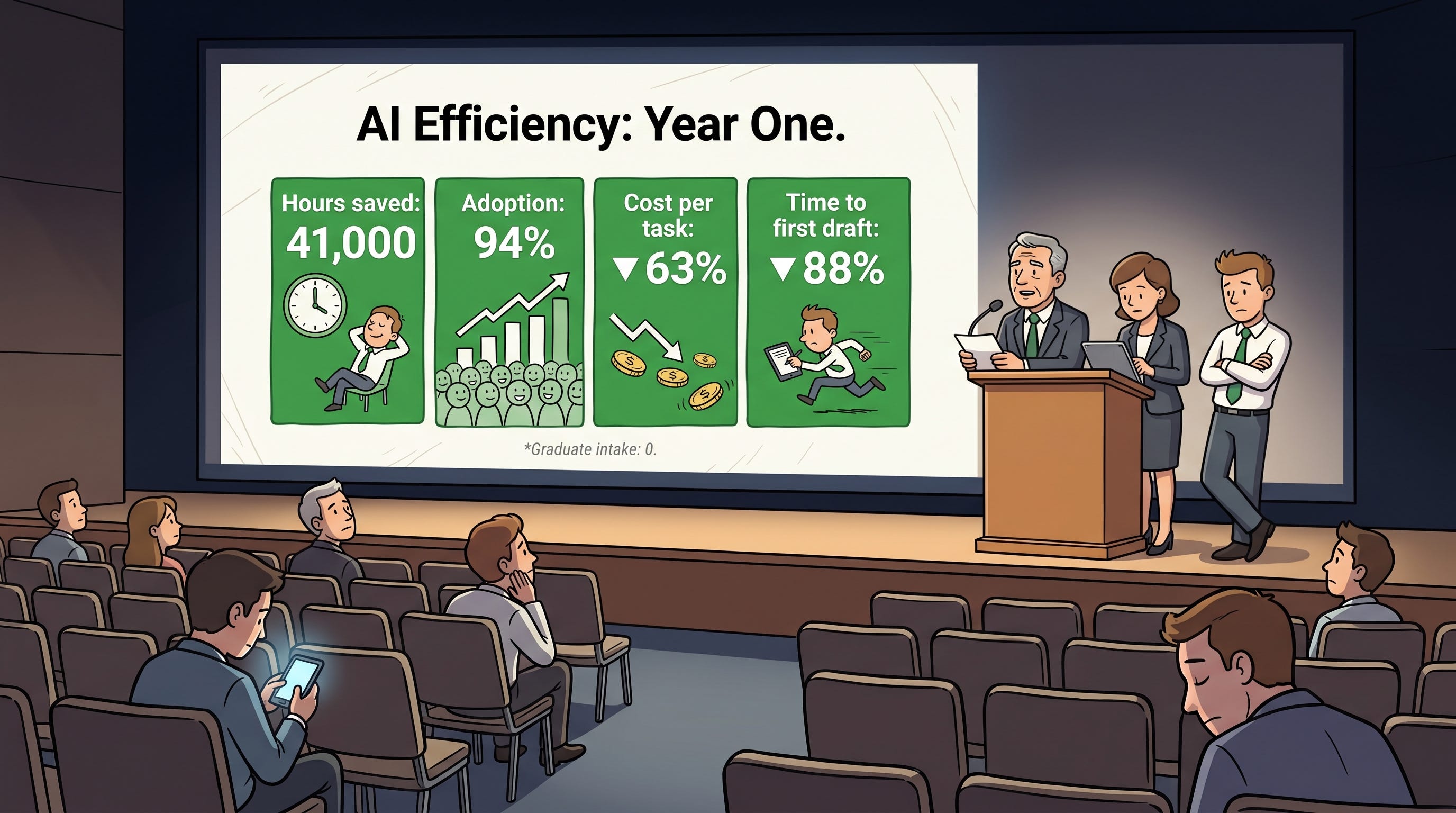
The cost surfaces as attrition, three years later, in a cohort nobody was measuring. This is the cost that no function owns, from the last issue, showing up in its second location. It is worse here, because the first time round the cost was diffuse and this time it is a person walking out of the building. We track tokens consumed and hours saved with real precision. We hold no lead indicator whatsoever for whether judgement is forming: not correction rates, not time-to-trust, not how often a junior catches a confident and wrong output. The instruments measure the efficiency of the work and are blind to the formation of the worker.
One organisation has done the obvious thing. IBM has reportedly tripled its US entry-level hiring this year on the explicit reasoning that gutting the pipeline now buys a senior shortage in 2029, and has rebuilt those roles around validating and integrating rather than producing. Whether it works is a question for the end of the decade. That it is a contrarian bet, and reported as one, tells you where the rest of the market is standing.
What was actually being built
The word I keep reaching for is one I inherited.
Franco D’Egidio, whose book I wrote about two issues before this one, used employeeship (Claus Møller’s term) for the qualities that make someone a capable participant in an organisation rather than merely an occupant of a role: responsibility, initiative, competence. His point, and Møller’s, was that these are not taught. They form through being trusted to act, allowed to be wrong, and made to absorb the consequence.
Checking output develops none of the three.
It cannot develop responsibility, because the work was never yours.
It cannot develop initiative, because the task begins after every decision has been taken.
And it develops a strange, hollow competence: real fluency at recognising a wrong answer, in someone who has never had to produce a right one.
That third one is the oldest idea in this issue and the one I have circled all the way through it. Competence, in the sense the professions mean it and the sense the guilds meant it before them, is mastery: a standing you earn by answering to the standard of the work itself, over time, in public, in front of people who can tell. It is not a stock of knowledge you hold. It is the reason a surname like Smith or Ferrari or Schneider exists at all: for most of European history the craft was the name, because what you could do was who you were. Remove the gradient and you do not merely slow that down. You sever the only route to it we have ever had.
So the missing junior loop is an organisation design failure with a delay on it, and the delay is roughly the length of a career. It is not, in the end, a hiring statistic or a labour-market argument. We are removing the preparatory work because it was the easiest thing to justify removing, and we were right that it was inefficient. We were simply wrong about what it was for.
The next newsletter issue will ask what we want people to become. I do not think that question can be asked honestly yet.
Because before you ask what you want a person to become, you have to be straight about what you took from the ones who were already on their way, and about the fact that you took it without ever deciding to.
So, one question, and I would like your answer. In your organisation, where does a twenty-four-year-old now go to be wrong about something that matters?
If you can name the place, tell me. I would like to know what it looks like, because I am not finding many.
If you cannot, then you already know what your firm will be short of in 2032.
Sergio
References
Catalini, C., Hui, X., & Wu, J. (2026). Some Simple Economics of AGI. arXiv:2602.20946. https://doi.org/10.48550/arXiv.2602.20946
Garicano, L., & Rayo, L. (2025). Training in the Age of AI: A Theory of Career Viability. CEPR Discussion Paper DP20634.
Brynjolfsson, E., Chandar, B., & Chen, R. (2025). Canaries in the Coal Mine? Six Facts about the Recent Employment Effects of Artificial Intelligence. Stanford Digital Economy Lab.
Emanuel, N., Harrington, E., & Pallais, A. (2026). Remote Work Leaves Younger Workers Sidelined. Liberty Street Economics, Federal Reserve Bank of New York. https://doi.org/10.59576/lse.20260601
Møller, C. (1994). Employeeship: The Necessary Prerequisite for Empowerment. Empowerment in Organizations, 2(2), 4–13.
Birkmeyer, J. D., Stukel, T. A., Siewers, A. E., Goodney, P. P., Wennberg, D. E., & Lucas, F. L. (2003). Surgeon Volume and Operative Mortality in the United States. New England Journal of Medicine, 349(22), 2117–2127. https://doi.org/10.1056/NEJMsa035205
2. Site Updates
A note on the site itself: sergiocaredda.eu hasn’t been updated in some time, and I’m aware of it. The blog rework is one of the things on my list for the next few months, and the Organisation Evolution Framework page itself will be revised as part of that work.
One thing that has stayed alive is the Leadership Models Collection, which I’ve continued to expand quietly through this period. Most recently I added entries on Multipliers, Humble Leadership, Host Leadership, Complexity Leadership Theory, and Resonant Leadership. It’s becoming a useful reference resource on its own, even ahead of the broader site refresh.
3. Reading Suggestions
The Certainty at the Heart of AI Anxiety — Nir Eyal. The Substack pick. Eyal’s argument is that the fear of AI comes dressed as a prediction and is really a demand for certainty, and that the useful move is to separate what you actually know from what you have decided to believe. Read next to an issue that spends half its length refusing to claim more than the evidence carries.
Workplace Learning and the Future of Work — Beier, Saxena, Kraiger, Costanza, Rudolph, Cadiz, Petery & Fisher, Industrial and Organizational Psychology, 18(1), 2025. The scientific pick, from Zotero. Eight authors arguing that our field has taken an organisation-centred view of development — people developed as a means to the firm’s ends — and that it needs a person-centred one. The exact argument this issue does not make, by people better qualified to make it.
Il part-time obbligato che colpisce soprattutto gli uomini e i più giovani — Fabio Savelli, Corriere della Sera. Involuntary part-time work in Italian retail, falling hardest on the young. A completely different mechanism from anything in this issue, producing the same outcome: an entry point that no longer carries anyone anywhere.
Why Change Is Outpacing Absorption Capacity — Latent Variables. On the changes an organisation never sees — local, unlogged, and cumulatively larger than anything in the change portfolio. The measurement instinct here is the right one, and it is the instinct this issue argues is missing everywhere else.
Management consulting as we know it is over — Jannie van Zyl, TechCentral. The deck was never the value, and now the deck is free. What is left is people who have actually done the thing — which raises the obvious question of where the next ones come from.
4. The (un) Intentional Organisation 😁
5. Keeping in Touch
Don’t hesitate to reach out by directly hitting “reply” to this newsletter or using my blog’s contact form.
I welcome any feedback on this newsletter and the content of my articles.
Find me also on: