



1. The Adoption Debt
In May, Uber’s President and COO was asked whether the company’s very large spending on AI coding tools was producing better products for the people who use Uber. His answer, on the record, was that the link is not there yet.
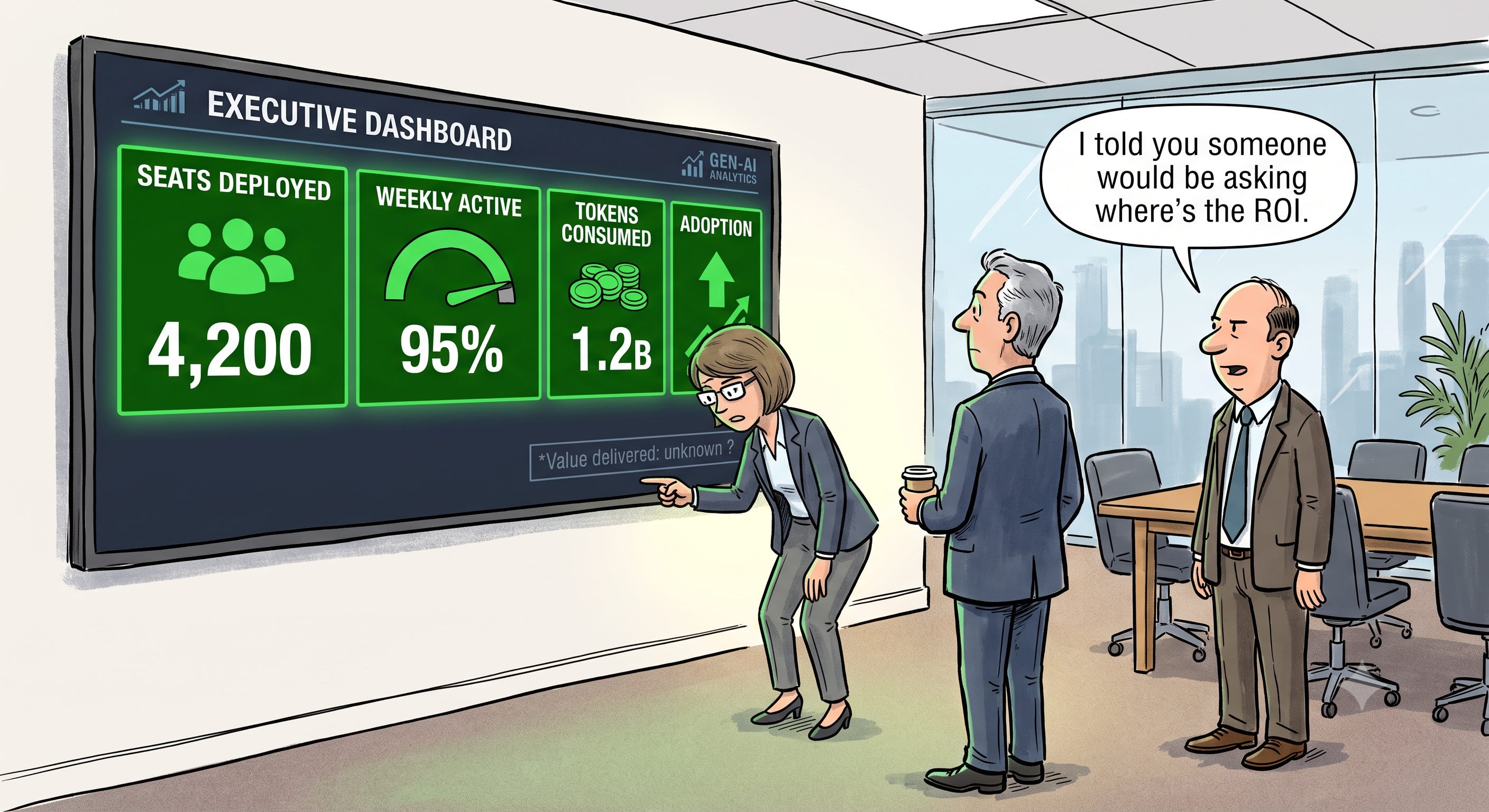
Uber is not a laggard. Ninety-five per cent of its engineers use AI tools every month, around seventy per cent of the code they commit is machine-generated, and the company had spent its entire 2026 budget for these tools by April. Its Chief Operating Officer still cannot draw a line from any of it to a single thing a customer would notice — which is awkward, because we are all being sold the same story, this time by people selling models instead of methods.
The metrics we are reaching for — seats deployed, tokens consumed, percentage of engineers “using AI weekly” — are all measures of input. We have built an entire reporting apparatus for a transformation, and it measures how much we are putting in rather than what is coming out. Uber, Microsoft and Duolingo have now all said versions of this out loud, which suggests something structural rather than three companies being unlucky.
Let me name what I think is happening, and then spend the rest of this issue arguing with myself about it.
The gain is booked at the task. The cost lands in the system.
Two definitions, because the distinction is the whole argument:
A task-level gain is real, local, and immediately legible. The analyst drafts the summary in four minutes rather than forty. It appears in the tool’s own dashboard, which is precisely why we can see it.
A system-level cost is real, distributed, and legible to nobody in particular. The extra coordination because three teams now produce four times the output that must still be integrated. The review load. The quiet erosion of shared context that used to make handovers cheap.
The first goes into a slide. The second goes nowhere, because no function owns it — and a cost that no function owns is not a cost, it is a deferral.
I am not describing anything new. Four years ago I wrote about Organisational Debt — Aaron Dignan’s idea that organisations pay interest when their structures and policies stay fixed while the world moves, and that the interest arrives as reduced speed, capacity, flexibility, innovation and engagement.
Adoption Debt is a species of that genus, incurred by one specific decision of this decade: deploying an extraordinary capability into a coordination architecture designed for something else. What I wrote then was that the debt is usually out of control before anyone notices, because there is no awareness of its impact until conditions make it obvious the interest cannot be paid. That is a reasonable description of a COO discovering in April that the year’s budget is gone.
Let’s see what it looks like from inside a company that is actually good at this.
Zapier is about as favourable a case as exists. Wade Foster describes what happened when the engineers started producing much more code: the bottleneck moved. It moved to code review — and fixing it was not a matter of giving reviewers better tools. They had to rebuild the review process from the ground up, get time-to-ship from days down to minutes, and it required the whole engineering organisation to agree to work differently, not one engineer to work faster.
That is the entire argument in an operator’s own words. Task-level gain, cost lands in the coordination layer, and the remedy is a design decision nobody can take alone. Zapier paid the debt down. Most organisations are still booking the gain.
Now the honest part, because the evidence is not as clean as I would like.
The obvious move here would be to reach for the engagement numbers. Gallup’s most recent report puts global engagement at twenty per cent for 2025 — a second consecutive annual decline from a peak of twenty-three per cent in 2022, and the first back-to-back fall since the series began in 2009. It is tempting to hold that against the AI adoption curve and let you draw the line.
I am not going to, because the source does not support it. Gallup’s own reading points at managers: manager engagement has fallen nine points since 2022, and the historic gap where managers were more engaged than their teams has closed entirely. That timeline starts in 2023, before most of us had deployed anything at scale.
So the honest version of my argument is weaker than the one I wanted, and I think more useful. AI did not break the coordination layer. It is arriving on top of a coordination layer that was already thinning. We spent a decade removing management layers in the name of agility, and we are now pushing an enormous volume of faster, less contextualised output through what remains. The debt is not the cause of the collapse. It is the accelerant on a fire somebody else lit.
But here is what I actually want you to take from the Gallup number, and it is not the number.
Gallup did not find the story in the headline figure. Twenty per cent tells you nothing. They found it when they cut the data by hierarchy level — and a flat, unhelpful score turned into a structural finding about where the load had moved. One cut, one question somebody thought to ask.
Andrew Marritt makes a sharper version of the same complaint, and it is the best thing I have read on engagement measurement in years. The evidence underneath it is unambiguous: across daily diary studies, about forty-two per cent of the total variance in work engagement sits *within* the person rather than between people. It moves day to day, with conditions, resources and events. Measuring it once a year, he says, is like photographing a river and calling it the flow.
A score describes the current state of the stock. The text explains the rate.
Which is exactly the distinction this newsletter has been circling. A stock is what you have accumulated. A rate is what is happening to you. And when Marritt models engagement as flows rather than a level, the practical finding is uncomfortable: what moves the number is reducing the rate at which people become disengaged. Re-engaging the already-disengaged barely shifts it — and where it does happen, it comes from structural change, a new manager, a new role, a new team, not from a programme. There is, he notes, no good evidence that organisation-wide engagement initiatives, better communication or recognition schemes produce individual recovery.
Read that next to the debt metaphor and it stops being a measurement argument. You cannot repay organisational debt with a programme. You repay it by refactoring. Marritt has the data for a claim I made four years ago from theory and experience.
And it raises the question I cannot stop turning over. If one cut by hierarchy revealed that much, how many cuts are we not making?
Different Meanings. Diversified Debts.
Because the engagement survey, as almost all of us run it, asks people how they feel about their work as though work meant the same thing to all of them. It does not.
Let’s consider three people in the same function, answering the same instrument, this quarter.
Sarah, our first employee built a craft. The slow, irritating, preparatory part of the job — the drafts nobody saw, the versions that failed — was not overhead. It was the medium through which she became good. AI has removed exactly that, efficiently and completely, and left her checking outputs. She does not experience this as relief.
Jack, our second employee, was on a gradient. Every year the work got harder in a way that made him “more”. He could feel himself becoming someone. That gradient has flattened — not because anyone demoted him, but because the rungs he would have climbed are now done by a system and nobody replaced them with different rungs. He is not disengaged. He is becalmed, which is a different thing and reads identically on a five-point scale.
Clara, the third, never chose any of this. The work was imposed, the relationship to it already transactional, and now it is faster and more surveilled, because the monitoring is built into the tools we just bought. AI has not removed her meaning. It has removed the last of the slack in which meaning might have been improvised.
All three answer the same question. All three land inside one number. The number falls by a point, and we write in the board pack that engagement is a concern.
The strongest objection to all of this comes from Foster himself, and I want to put it properly rather than wave at it. His view is that we assess loss far more easily than gain, that the tasks AI is taking were frequently not very interesting or valuable in the first place, and that removing them frees people for more ambitious work.
He may well be right about the aggregate.
My difficulty is that “not very valuable” is a judgement made from outside the work, usually by someone who is not doing it — and the preparatory tasks that look least valuable from a dashboard are very often the ones through which capability is actually built.
The question is not whether those tasks were worth doing. It is whether anything has been designed to replace what they were quietly producing.
So what is this a failure of?
I keep returning to a phrase from the book I wrote about in the last issue. D’Egidio’s diagnosis of Italian companies in 2003 was that they were sovragestite e sottoguidate — over-managed and under-led.
Twenty-three years on we are doing something with a familiar shape: deploying an extraordinary technology to make existing processes faster, rather than asking what value we are trying to create and what Work would have to look like to create it. That is a machine response to a living-system problem, and it is the most expensive kind of imagination failure, because it looks like progress the entire time it is happening.
Which makes it an Operating Model question. Not “how do we roll out AI” but: if this capability is real, what should the flow of value look like now — and which coordination, integration and meaning-maintenance work has to be designed in, because it used to happen for free in the layer we removed?
I do not have a tidy answer. I have a strong suspicion about where the bill lands first, and it is not on the three people above. It is on the ones who never got to build the craft at all — the juniors, whose entire development loop was made of the tasks we have just automated. That is the next issue.
For now, one question, and I would like your answer. In your organisation, who owns the cost that no function owns?
If you can name them, tell me how they got the job.
If you cannot, I think you have found your adoption debt.
Sergio
2. Site Updates
A note on the site itself: sergiocaredda.eu hasn’t been updated in some time, and I’m aware of it. The site rework is currently being done, and you will see a complete new revamp at the end of August. Keep tuned!
3. Reading Suggestions
AI Is Moving Faster Than the Organisation Can — Richard Claydon, Leadership, Rewritten. Three clocks running at different speeds — the tool, the workflow, the institution — and the strain of their misalignment quietly absorbed by the people translating between them. The best short statement I have read of why adoption is not transformation.
Studying Within-Person Changes in Work Motivation — Navarro, Rueff-Lopes & Laurenceau, Revista de Psicología del Trabajo y de las Organizaciones, 38(1), 2022. The methodological companion to the argument above: if you want to see change inside a person rather than between people, you need far more measurement points than anyone actually collects. Which is a polite way of saying most of what we run cannot detect what we claim to be looking for.
The Analyst Who Changed Nothing — Andrew Marritt. Part two of the series that gave this issue its stock-and-rate distinction. People analytics has spent fifteen years improving analysis quality when the thing that matters is decision quality.
The AI Operating Model Is Discovered, Not Designed — Stuart Winter-Tear also lands in my exact same direction, i.e. of AI adoption being an Operating Model issue, that needs to be “discovered”.
4. The (un) Intentional Organisation 😁
5. Keeping in Touch
Don’t hesitate to reach out by directly hitting “reply” to this newsletter or using my blog’s contact form.
I welcome any feedback on this newsletter and the content of my articles.
Find me also on: