



1. The Book That Shaped My Thinking
Dear friend,
The first proper job I ever had came with an odd instruction: write this man’s book, but make it sound like him, not like you.
It was the autumn of 2000. I had just walked into the Milan offices of Summit as a freshly minted Human Capital consultant — a title I fell in love with the moment I first saw it published on the job-search portal. The man was Franco d’Egidio, a prolific author of management books and an adviser to a good number of the more interesting Italian entrepreneurs of his generation. Over the next few years I helped him write three of them. The one I keep coming back to is La Nuova Bussola del Manager, published by ETAS in 2003.
I want to write about that book today. Not to review it — that would be a strange thing to do to a book you helped write — but because I have slowly realised that almost everything this newsletter (and some of my previous writings) has been arguing for the past few years was already sitting in its pages, in a language I did not yet have the experience to read.
Ghostwriting does something peculiar to you. You spend months thinking inside someone else’s argument, holding distinctions you did not draw, defending positions you did not originate and might not yet believe. You learn a structure of thought before you have earned it. And then, if you are fortunate, twenty years later you discover you have grown into it — and that the ideas you were merely transcribing have been quietly running your head ever since.
Let me pick out five of them. I will be brief with each, not because they are small, but because each one deserves — and is going to get — its own treatment in the issues ahead of this Newsletter.
1. Organisations are not machines.
The first is that the organisation is not a machine. D’Egidio’s starting move was to call most companies sovragestite e sottoguidate — over-managed and under-led. Drawing on von Bertalanffy’s systems theory and Gareth Morgan’s images of organisations, he insisted that a company is closer to a living thing than to a mechanism. A machine can only optimise the present. A living system can renew itself. That distinction is the seed of everything I now believe about operating models.
The organisation is not a mechanism but a social system — a living system — and as such it must be nourished. It needs particular attention; it needs to be led, not managed; inspired, not controlled.
Franco D’Egidio, La Nuova Bussola del Manager
2. Value is a system, not a number.
The second is that intangible value is a system, not a number. One of D’Egidio’s big intuitions was that Intangibles needed proper measurement to be “revealed”, so that a company’s real value, behind pure financials could be seen, developed fully in the other book I worked on with him: Il bilancio dell’intangibile. There you can follow the concept from D’Egidio’s original intuition through to the methodology the Summit team and I built around it. The worth of a company is based on four interdependent capitals — human, social, structural, relational — that feed one another rather than sitting in separate columns. Years later, that became, for me, the argument that organisational capability is a portfolio somebody has to hold, not a stack of unrelated assets.
3. Employees, not Leaders alone make the success of an organisation
The third is a concept that belonged to the network Summit was part of and that D’Egidio helped develop: employeeship. It came from Claus Møller and Time Manager International — TMI — and it names something we still barely have language for — that you cannot have good leadership without good followership, and that the disposition to take responsibility, show initiative and stay loyal to a shared aim is itself a designable organisational quality. We have shelves of books on how to lead. We have almost none on how to be led well contributing to the organisation’s success.
4. Trust is an infrastructure
The fourth is that trust is infrastructure, not sentiment. Following Fukuyama, the book argued that control and trust are not two ends of one dial but two incompatible operating logics, each with its own cost. Every unit of control has to be paid for — in surveillance, approvals, defensive paperwork. Every unit of trust pays you back. You cannot bolt a trust initiative onto a control architecture and expect anything but cynicism.
5. The importance of vitality
The fifth is that every organisation has a vital force that can be measured before the financials show the problem. D’Egidio called this vitalità d’impresa — corporate vitality — and it was, in many ways, his most original contribution (also set out in an earlier book: La Vitalità d’Impresa). The argument is not simply that organisations fail from the inside, which is true but not his idea. It is that the decline is legible early, if you know what to read. Long before revenue stalls or margins compress, the vital signs are already moving: energy draining from the culture, initiative retreating upward, trust converting quietly into compliance. He spent years building a diagnostic instrument — the Early Warnings Decision System, built on eight intangible indicators — to detect exactly that. The idea that you can take an organisation’s temperature, not just its pulse, is one I have never stopped finding useful. In 2026, with AI adoption curves and engagement collapse moving faster than any annual survey can track, it feels less like a management tool and more like a survival instinct.
Now, the honest objection — because I can hear it, and I have made it myself. A sceptical reader would say this is exactly the thing we do to our own pasts: we read the present back into them and call it foresight. There is even a literature for it. Eric Abrahamson’s work on management fashion describes how ideas like intellectual capital and distributed leadership move through the corporate world in waves, manufactured and sold by consultancies, gurus and business magazines. D’Egidio had the enviable capability of turning simple management ideas into business opportunities that had an impact. The twenty-three books and two thousand-odd articles he wrote are there to account for it. So, yes, I do accept the objection, but the fact that Intellectual Capital is once again coming out as an imperative in the age of AI, shows that seeds were planted back then.
But here is why I do not think it settles anything. The test of an idea is not whether it was fashionable when it was written, but whether it still cuts once the fashion has passed. And these ones cut harder now than they did then — because AI has made every one of them live again. We are being told, once more, that our organisations are machines to be optimised, this time by people selling models instead of methods. The control logic has never been cheaper to choose: the monitoring is built into the tools. The living-system question, the trust question, the lock-in question are not nostalgia. They are the questions a frightened decade is most tempted to skip.
There is one more thing I took from d’Egidio — less a chapter than a habit of mind he taught in person. He used to say a leader needs three faculties: insight, foresight and intuition — an argument he develops across several chapters of Vision and Leadership, the book of his that sold most. What follows is my own compression of it rather than a passage you could quote back to him. Insight is reading the present clearly — seeing what is actually there rather than what convention suggests. Foresight is holding several possible futures at once without collapsing too early onto one. Intuition is the compressed past: the pattern recognition that lets you act before the evidence is complete. Three time signatures, really — the now, the not-yet, and everything you have already lived. And the five ideas are really those three faculties in working clothes: to see an organisation as a living system rather than a machine is an act of insight; to build trust and capability for a future you cannot yet read is foresight; to feel the vital signs fading before the numbers show it is intuition.
It is also, I realise, the shape this newsletter has been tracing without my planning it. The last stretch of issues was an exercise in insight — trying to see the design gap clearly. What comes next leans on foresight, holding the AI-era futures open long enough to think. And the whole thing rests on intuition, the part I cannot fully account for, which is presumably why a book I transcribed at twenty-five is still the one I am arguing with at fifty.
With an added note. The line he quoted more than any other was McLuhan’s: se qualcosa funziona, è obsoleto — if it works, it’s obsolete. He borrowed it, and made it his own. A real jolt for someone like me, who has always believed transformation and change are good things.
So this is less a tribute than a confession of lineage. Twenty years on, the ideas I was once just typing have turned out to be the compass — the bussola — I never stopped using. What I keep asking myself is which of the things we are being sold today will look, in another twenty years, like the seedbed of something real, and which will look like the fashion of a frightened decade. I do not know yet. I suspect the difference will come down to whether we treated our organisations as machines or as living things.
More on each of these, in the issues to come.
Sergio
2. In memory of Franco D’Egidio
Franco D’Egidio died on the first of August 2007. This issue publishes nineteen years later, in the same week.
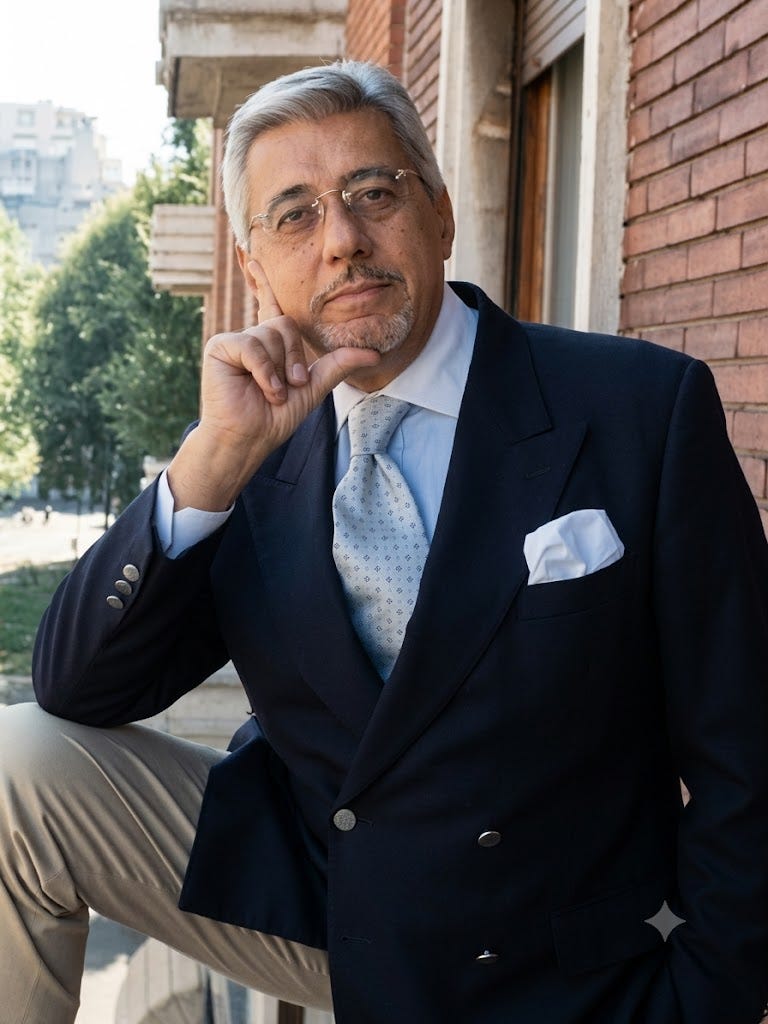
I worked with him at Summit between 2000 and 2005, my first job. I helped him write three books, taking his ideas from conversation and whiteboard and turning them into tools managers and entrepreneurs could use (this is how he intended his books). The acknowledgements are generous about what I contributed. What they do not say, is what that process gave me.
He had a way of holding an argument the way a good navigator holds a compass — with enough confidence to commit to a direction, and enough humility to know the sea changes. He thought organisations were alive. He thought people deserved to be treated as the primary asset, not a cost line. He wrote that before it was fashionable, and he meant it in a way that many people who now write it fashionably do not. Yet, he was able to influence and leave a mark to some of the most important entrepreneurial companies in Italy still today, like Brembo, Technogym and Intercos.
He also took these ideas into places most consultants would not follow — public administration, non-profit, small entrepreneurs, sectors where the gap between management theory and daily practice was widest. He did not write for an audience of people who already agreed with him.
In the last weeks of his life he launched the Intellectual Capital Value Award — a prize for companies that had done real work on their intangible capital. The honorary committee he assembled for it ran from Confindustria and ASFOR to the president of AIAF, the Italian association of financial analysts. That he could persuade a body of financial analysts to put its name to a prize for intangibles says something about how far he had pushed the argument. He died a few days later. The award was given the following year and dedicated to his memory.
“Gli uomini imparano fino a che vivono, le imprese vivono fino a che imparano.”
Men learn as long as they live. Organisations live as long as they learn.
He believed that. He was right.
Sergio
3. Site Updates
A note on the site itself: sergiocaredda.eu hasn’t been updated in some time, and I’m aware of it. The site rework is currently being done, and you will see a complete new revamp at the end of August. Keep tuned!
4. Reading Suggestions
The Uncertainty in the Room — Jan Oliver Schwarz, The Foresight Brief. The clearest short piece I have read on foresight as a discipline: not predicting one future but building the tolerance to hold several. The middle faculty of the triad above, written up for 2026.
Is command-and-control leadership back in fashion? — Fast Company. A neat illustration of the trust-versus-control binary returning under the cover of crisis — and of how quickly a management fashion can swing back when leaders are anxious.
Will AI Yield Abundance Without Purpose? — Carl Benedikt Frey, Project Syndicate. Frey asks whether automation can manufacture meaning as easily as it manufactures output. It cannot, which is precisely why the human-capital question never went away.
What you can learn about organisations from a controversial German philosopher — Sam Spurlin. A Heideggerian argument that an organisation lives in its relationships and purpose, not in its org chart — the living-system metaphor arriving from an entirely different door.
5. Keeping in Touch
Don’t hesitate to reach out by directly hitting “reply” to this newsletter or using my blog’s contact form.
I welcome any feedback on this newsletter and the content of my articles.
Find me also on:
This is truly enlightning. I don't know if I was in debt to this man or if we had similar ideas. I suspect the former, due to the nature of knowledge. The fact is: I always approached organisations as organisms driven by culture (values?), and valued intangibles more than tangibles. Maybe @Carlotta Silvestrini agree on this. Only leadership for me is more understandable in the framework of Bellotto and Trentin model. Great piece and useful insights, as always.