



A Capability, Not Culture
Almost every conversation I have had this year about AI and human work ends in the same place. Someone says that in the end it will come down to the human qualities, the judgement and the creativity and the care, the things the machine cannot do. Everyone nods. The meeting closes. Nobody asks what would have to be different on Monday morning, and nobody puts a number against it.
I think the sentiment is broadly right. My problem is with what happens next, which is nothing, because a claim that cannot be acted on cannot be checked either. “Humanity will save us” is comfortable precisely because it is unfalsifiable. If the organisation does well, the humans made the difference. If it does badly, we did not invest enough in the humans. There is no version of the world in which the statement is wrong, and that is not a strength.
You can see the shape of it in the way the argument gets made. The idea that companies choosing augmentation over automation may win in the long run is now close to received wisdom in HR circles, and it is repeated by people with a lot of authority. Read the title again, though: may. What carries it is a well-argued case about how employees’ perceptions will shape results, not a tested outcome. That is fine as an argument. It is not fine as the load-bearing wall of a business case, and it is being asked to hold up quite a lot of weight.
Part of the conversation about HR as an actor in AI implementation grows from the same tree. We feel reassured that someone is going to defend the human side against the evil of automation, and we rather like that the someone is us. It is a comfortable position for my profession, and an unexamined one, because defending the human side is not the same as saying what it consists of.
So I would like to specify what the human answer would actually consist of.
The idea has a name, and it is ten years old
In 2016 Robert Kegan and Lisa Laskow Lahey published An Everyone Culture, and gave the field the term Deliberately Developmental Organisation. The claim was simple and quite radical: most organisations run development as a programme beside the work, and a small number run it as the operating logic of the work itself. In those organisations, being visibly not yet good at something is not a risk to be managed but the ordinary condition of employment. I read it when it came out, reviewed it on my site, and gave it five stars.
I want to come back to that review later, because it has a problem.
First the useful part. What Kegan and Lahey did was specify. Not “invest in people”, which means nothing, but: name a growth edge, build the daily groove that makes people work on it, and hold enough safety that the struggle is survivable. Edge, groove, home. You can argue with all three. You cannot accuse them of vagueness.
There is, however, an element I do not agree with. Kegan and Lahey made development a property of the culture. I think that was the wrong object, and I think the last decade has shown why.
Why culture is the wrong object
Culture is where organisational claims go to become unmeasurable. This is not a complaint about consultants, it is what the evidence says: the CIPD’s evidence review finds the direct effect of cultural values on objective organisational performance sitting close to zero. Whatever culture is doing, it is not reliably showing up where the money is counted, and it shows up rather more strongly when organisations are asked to score themselves.
So a prescription that lands in the culture layer inherits that problem. It also inherits something worse. The way I use the term, culture is emergent: the pattern of how things are actually done, which nobody authors directly. That is exactly what you want when you are trying to understand an organisation. It is a problem when you are trying to change one, because an emergent property has no budget line, no owner, and no moment at which anyone has to decide anything about it.
A capability is a different kind of object, and this is the move I want to make in this issue.
Culture is something an organisation is said to have. It emerges from everything else the organisation does, and it is described, surveyed and aspired to. Nobody owns it and nobody pays for it.
A capability is something an organisation holds. It should have an owner and a development path, it competes for investment against other capabilities, and somebody can be asked why it is not better than it was last year.
The should is doing honest work there. Plenty of organisations do not run their capabilities that way either, and I have written about what happens when capability-building starts before anyone has defined where the capability is supposed to act. But a capability can be given an owner. Culture cannot.
Treating deliberate development as a capability rather than a culture does three things at once. It gives the claim a place to live in the operating model. It puts it into the portfolio, where it has to argue for its funding like everything else. And it makes it accountable in the only way organisations actually recognise, which is that a named person has to answer for it.
It also does a fourth thing, which nobody in this literature seems to want to look at.
The right nobody asks for
If development is a capability, then it sits in the capability portfolio. And a portfolio is not only a set of things you build. It is a set of things you hold, combine, and eventually retire.
Functional ownership is very good at building a capability and structurally very bad at disposing of one. No function has ever volunteered that its own capability has stopped earning its keep. So organisations accumulate. They add the new capability beside the old one and call it transformation.
Which means the missing right is not ownership. It is disposal. Somebody has to be able to decide that a thing ends.
Apply that to development and it gets uncomfortable fast, which is how you know it is a real question. When do you stop developing a capability? Who is allowed to say that a skill your people have spent fifteen years building is no longer one the organisation needs? Kegan has no answer to this, because a culture has no disposal mechanism. An organisation that has made everyone a learner, always, has no way of saying: not that, not any more.
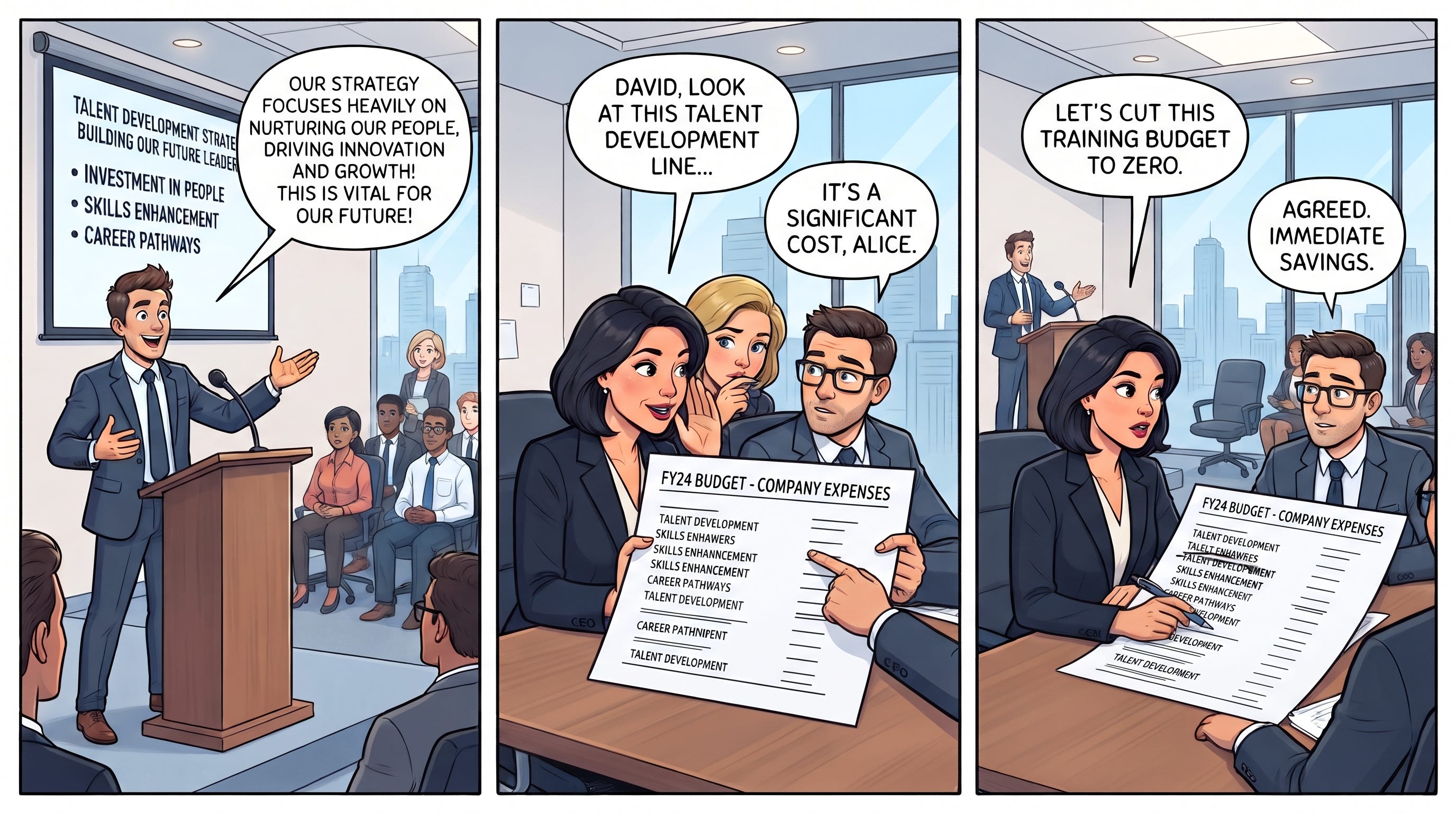
I do not have a clean answer. I can see roughly where one would have to come from, though. Every other capability in a portfolio has a moment at which somebody is obliged to look at it: a review, a funding cycle, a point where continuing requires a decision rather than the absence of one. Development has no such moment, which is why it is never retired and also why it is never properly funded. Those two facts are the same fact. It is also why so many talent strategies end up dismissed as “the HR thing”: written with care, presented with conviction, and never given resources that anyone would have to defend in a budget meeting. Nobody is obliged to fund what nobody is obliged to review.
So if I had to sketch the mechanism, I would put it there. Not a committee for shutting things down, which would be captured within a year, but an obligation that the portfolio is re-argued on a cycle, capability by capability, with a named person who has to say why each one is still worth holding and what it is costing to hold it. Disposal then stops being an act anyone has to perform. It is what happens to a capability that fails to survive its own defence.
That is a direction rather than a method, and I would rather leave it that way than dress a sketch up as a design. What I am fairly sure of is that it is the question, and that it is the one separating a developmental organisation from a sentimental one.
Two preconditions, and they fail from opposite directions
Before any of this, there are two things that have to be true, and the literature tends to skip both.
The first I owe to Franco D’Egidio, whose La Nuova Bussola del Manager I worked on more than twenty years ago and keep returning to. Drawing on Fukuyama, he treated trust not as a sentiment but as infrastructure: a design choice made upstream of everything else, which then determines what is possible downstream. You cannot build a deliberately developmental organisation on a control infrastructure. Not because control is morally worse, but because the two are asking the same person for incompatible things. Development requires a visible version of you that is not good enough yet. Control is a system for noticing exactly that and pricing it.
The second precondition runs the other way, and Lisa Gill put it in a single question: who am I to give you feedback? Feedback is the core developmental tool. It is always difficult, and hierarchy, for all its faults, settles one thing about it: who is expected to give it to you. The answer is unattractive, but it is clear. Take the managerial structure out, flatten things, distribute the authority, and that implicit permission goes with it. Nobody is obviously entitled to tell you your work is not there yet, so the conversation quietly stops happening, and everyone reports that the culture is excellent.
This is not an argument against flat organisations. Some of them develop people very well. Buurtzorg, the Dutch home-care organisation run by self-managing nurse teams, is the case everyone cites, and what gets cited less is how much deliberate design sits underneath it: teams capped at twelve and split when they grow, coaches whose whole job is helping the teams rather than reporting on them. The peer patterns work because somebody designed them, and kept designing them. Fieldwork inside an Italian self-managing company, written up this summer by Alberto Zucca, Tine Bieber, Edoardo Ghignone and Luca Solari, shows the same thing from the inside: an organisation genuinely flat in how the work gets done, and still dependent on one person to keep holding what the freedom means. Most organisations do something else. They copy a pattern, agile being the usual one, remove the hierarchy that was quietly doing the feedback work, and pretend that development will carry on by itself.
So: too much control and development is not safe. Too little structure and it is not sanctioned. Both failures look like nothing happening, which is why neither shows up in a survey.
What the machine actually took
Now the AI part, and I want to be narrower here than the genre usually is.
I wrote in the last issue that the preparatory work that used to build competence is exactly the work that is cheapest to automate, which leaves Ben very good at checking and possibly building nothing underneath.
But there is something more specific that I think the discussion is missing, and it took me a long time to see it because I lived it without noticing.
Early in my career I spent years writing in someone else’s voice. What I took from it was not skill. It was the order in which he approached a problem: what he looked at first, what he refused to answer until later. I was reproducing that sequence for years before I noticed I had it, and nobody has taught it to me since.
That is what the gradient was transmitting. Not technique, which is quick to teach and is now being taught by a machine, but the shape in which a competent person holds a problem, arriving through long articulate work and arriving invisibly. A development system that builds competence and not articulation has restored the wrong half. Every proxy we use, the certification, the completion rate, the skills matrix, measures the half that was never the scarce one.
Ghostwriting did this by accident. A development system would have to do it on purpose. What would that look like? Think about asking someone to walk through the order in which they approached a problem before showing the result, and having a senior person say where their own order would differ. It produces nothing a client ever sees, it takes a senior person’s time, and it is exactly the kind of work that disappears first when the machine makes the output free.
And then there is Clara
I have been writing this as though more development is straightforwardly good. For a lot of people it is. I want to stay honest about the ones for whom it is not.
Think about someone who never chose this work in any meaningful sense. It was the job that was available. It was already transactional before any of this started, and the tools that arrived this year made it faster and rather more closely observed, because the monitoring came bundled with the software. Now that same organisation announces that it is becoming developmental. It would like her to name her growth edge, in a shared document, to a manager.
What is being asked of her? She is being asked to make her limitations legible to an institution that already holds a great deal of information about her and has never used any of it in her favour. The offer of development, from a party that holds the power, can land as one more extraction, and it can land that way without anybody intending it.
There is a serious version of this concern in the research literature, and it is more damning than the sceptical version I hear in practice. Emily Ruppel’s ethnography of a job-training programme describes what she calls therapeutic management, which among other things aims to transform structural problems into individual ones. Her setting is a specific one and I would not stretch the finding beyond it, but the mechanism travels. A developmental frame can relocate a design failure into a person’s growth plan. The workload does not change. The staffing does not change. What changes is that the problem now has your name on it.
I have watched a milder version of this in organisations a long way from low-wage work. An organisation-design problem gets turned into a leadership development programme. That is not necessarily a bad thing: people learn, and some of what they learn is useful. It becomes one when the entire effort is relocated onto individuals, who are asked to solve through their own growth what the structure keeps producing, and whose reward, at the next restructuring that finally “sorts” the organisational issue, is a thank-you note attached to a severance package.
Note what this is not. It is not an argument against development. It is an argument that the same intervention has different meanings depending on who holds interpretive authority, which is to say: depending on who gets to decide what your growth edge is. Operational authority can be handed over by design. Interpretive authority, as the Italian fieldwork I mentioned earlier shows, moves only through long and deliberate investment, and if it has not moved, then “we will develop you” still means “we will continue to be the ones who say what you lack.”
I do not think this dissolves. I think it is the thing you hold while you build, and I am going to leave it open here rather than tidy it away.
About that five-star review
I said I would come back to it.
In December 2019 I reviewed An Everyone Culture and wrote that the Bridgewater case was probably the strongest in the book, and that the results showed it. That review is still on my site. I am not going to quietly update it, because what has happened since is more useful than a corrected page.
Kegan and Lahey built their argument on three organisations. Here is where those three are now.
Bridgewater has been the subject of sustained independent scrutiny, and the record is not good. In 2020 an arbitration panel found that the firm had manufactured false evidence against two former employees and brought one of its claims in bad faith. Those findings became public through the former employees’ own court filing, and Bridgewater has contested them, which is worth saying because it is exactly the kind of detail a sympathetic reader would prefer to skip. The firm’s own culture page now records that, when its founder handed over in 2022, it re-underwrote several of his principles.
Next Jump still describes itself as recognised by Harvard in 2016 as one of two top learning organisations globally, which turns out to be a reference to this book rather than to any institutional recognition. Decurion’s two cinema chains closed permanently in 2021; the company itself carries on.
And the wider evidence base is thinner than its reputation. I went looking, this month, for the studies that should exist after ten years of a widely taught idea: an evaluation of the model, a validated instrument for measuring it, longitudinal work, a replication at a fourth organisation. I did not find them, in any of the journals where they would belong. I would be glad to be corrected, and please send me a feedback if you think I missed something. The book selected three organisations that were already doing well and described their practices, which is the oldest problem in management writing: you cannot tell from a sample of winners which of their habits caused the winning.
So why am I still arguing for this?
Because none of that touches the mechanism, and because the alternative is worse.
The Bridgewater story is a story about what happens when developmental practice runs on a control infrastructure, with one person holding both the interpretive authority and the recording equipment. That is precisely the first precondition, failing exactly as you would predict. It is evidence for the design argument, not against it.
And the absence cuts both ways. The critical traditions that would take this model apart, the research showing peer discipline in self-managing teams turning out harsher than managerial discipline, and the work on identity as a form of control, have not been turned on these three organisations either, at least not anywhere I could find. We are not choosing between a tested claim and an untested one. Everybody here is operating on theory.
What we are choosing between is a specified proposition and an unspecified one. “Humanity will save us” cannot be wrong. “Name the capability, allocate the work developmentally, book the cost, protect the first bad attempt, and put it in the portfolio with an owner” can be wrong, in about six places, and you would find out.
So let me state my position plainly, including the part I cannot support.
I have seen these elements work, in pieces, across twenty-five years of transformation and change work. An upskilling programme built into the build decision of a strategic workforce plan, where developing people was costed and set against buying or borrowing them, which is the argument of this issue in miniature. The operating model of a spin-off, designed from the start as a service, where people grew into roles that had been drawn around a real flow of work. A redesign of how stores serve customers at the point of sale, where the learning followed the design instead of preceding it.
What those have in common is not a culture programme. In each case development was attached to a structural decision, and it worked because it had somewhere to land. I have never seen it work as a standalone initiative. And I have never seen the coherent version either: all of it, designed, owned, funded, in one organisation, over enough time to tell. That step is an assumption, and I am making it on purpose. I think it is time somebody tried this deliberately: take development off the culture slide, put it in the capability portfolio next to the structural decisions it depends on, and give it an owner who has to defend it.
How you would know it was working
An assumption you cannot disconfirm is just a belief with better manners, so here is the test, and it cuts in both directions.
A manager who develops people is running slower on purpose. They are giving work to someone who will do it worse and take longer, at a moment when a machine would do it instantly. That is a real cost, paid now, locally, by them, for a return that arrives later and lands somewhere else.
If that cost is invisible in how they are measured, they will stop. And they will be right to stop.
So the question is not whether your organisation believes in development. Everyone believes in development. The question is whether anything in your management system currently makes it rational to pay for it. Look at how your managers are actually assessed, this quarter, and find me the line where running slower on purpose is a credit rather than a variance to be explained.
If you can find it, and someone owns the capability that line protects, you are building the real thing, whatever you choose to call it. If you cannot, then you do not have a developmental organisation. You have a developmental aspiration, and the AI wave will make the arithmetic worse every quarter until somebody with the authority to redesign the measurement decides otherwise.
Who that somebody is, is next issue’s problem.
Sergio
References
Barends, E. and Rousseau, D. M. (2022). Organisational culture and performance: an evidence review. Scientific summary. London: Chartered Institute of Personnel and Development.
D’Egidio, F. (2003). La Nuova Bussola del Manager. ETAS.
Fukuyama, F. (1995). Trust: The Social Virtues and the Creation of Prosperity. New York: Free Press.
Kegan, R. and Laskow Lahey, L. (2016). An Everyone Culture: Becoming a Deliberately Developmental Organization. Boston: Harvard Business Review Press.
Ruppel, E. H. (2024). Therapeutic management in the low-wage workplace. Social Science & Medicine, 352, 117026. https://doi.org/10.1016/j.socscimed.2024.117026
Zucca, A., Bieber, K., Ghignone, E. and Solari, L. (2026). Il ruolo necessario degli artefici della libertà del self-management. Harvard Business Review Italia, luglio-agosto 2026. https://www.hbritalia.it/luglio-agosto-2026/2026/07/01/news/il-ruolo-necessario-degli-artefici-della-liberta-del-self-management-16622/
2. Site Updates
The new sergiocaredda.eu is live.
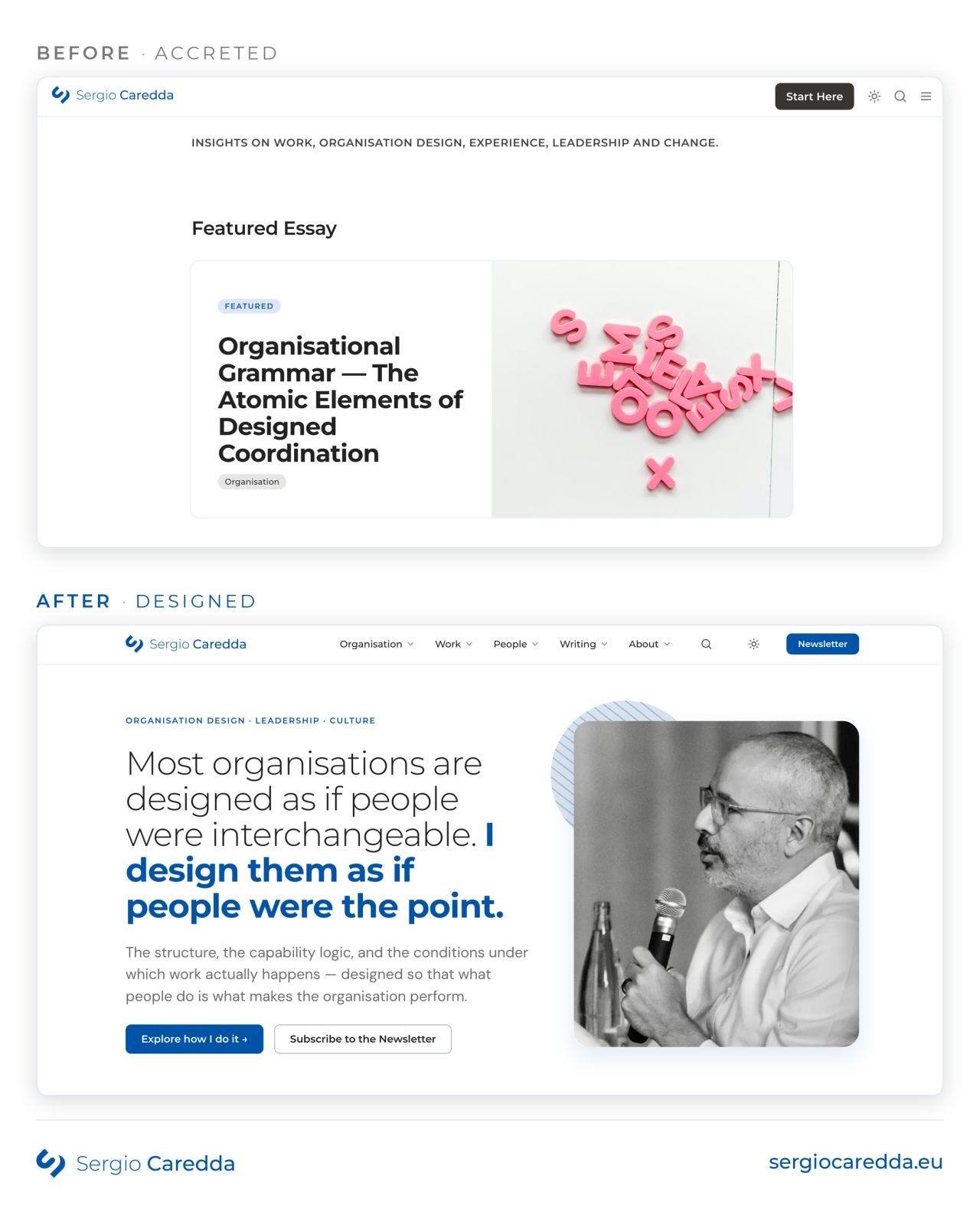
For twenty years my site grew the way most organisations do: by accretion. Every strategy left a layer behind, posts that had outlived their purpose, hundreds of tags, series that had lost their order. So I rebuilt it with the question I ask of any organisation I work with: what is this thing for, and does its structure say so?
What you will find there now:
The Organisation Evolution Framework at the centre, with a hub for each of its eight components. The Corporate Culture hub is the one this issue argues with.
281 models of leadership, organisation and strategy, each read through the same lens, among them the Deliberately Developmental Organisation.
Three pillars, Organisation, Work and People, written to argue rather than to file.
Twenty years of archive, kept and labelled rather than rewritten. Which is also why my 2019 review of An Everyone Culture is still there, exactly as I wrote it.
The most useful moment came on the last morning. An audit found my own working notes showing on sixteen published pages: the gap between the design and what actually runs, which I have seen in every organisation I have worked in. This time I could close it before lunch.
I have also closed the separate LinkedIn page I kept for organisation design. The work and the person were always the same thing, so everything now lives on the site, in this newsletter and on my personal profile. If something on the new site looks broken, or you cannot find a piece you remember, just hit reply.
3. Reading Suggestions
AI implementation isn’t just execution. It’s discovery. — Stuart Winter-Tear, Unhyped AI. The Substack pick. Putting AI into real work keeps revealing things the organisation did not know about itself, which makes redesign something you discover as you go rather than a step after the plan. A good companion to an issue arguing that development only works when it has a structural decision to attach to.
Coaching and its effectiveness in organizations: Reflecting on a decade of research — Woods, Jones & Guillaume, Journal of Occupational and Organizational Psychology, 99(2), 2026. The scientific pick, from Zotero. The authors look back over ten years of research since their 2016 meta-analysis on workplace coaching. Same decade, same kind of developmental promise as An Everyone Culture, and a very different evidence trail. Worth reading side by side.
Why AI is making organization theory even more relevant — Nicolay Worren. Agents need organising for many of the same reasons people do, and the old questions about dividing and coordinating work come straight back. Organisation design becoming more relevant with AI, not less, is a thread I will keep pulling.
Why Job Architecture is Failing Us — Lance Haun, Beacon Turn. Job structures were already struggling before AI, and AI is now pulling roles apart in two directions: some amplify expertise, others let less experienced people do the work. Read it with this issue in mind: an architecture of jobs is not an architecture of capabilities.
RenDanHeYi from Day Zero: Building a Startup as a Distributed Organization — Emanuele Quintarelli, Chaordian. A small startup built as a distributed organisation from its first day, with autonomy designed in and extended step by step. The opposite of copy-and-paste, and a small-scale picture of the intentional design I argue flat structures need.
4. The (un) Intentional Organisation 😁
5. Keeping in Touch
Don’t hesitate to reach out by directly hitting “reply” to this newsletter or using my blog’s contact form.
I welcome any feedback on this newsletter and the content of my articles.
Find me also on:
What stood out to me is the idea that AI can remove not only work, but also the gradient through which people used to learn how to hold a problem.
That seems especially important when redesigning work around AI. “What should this person stop doing?” is a useful question, but perhaps it needs a companion: “What will this person no longer learn if we remove it?”
Some tasks are pure repetition and should disappear. Others may be carrying hidden developmental value — not because the output matters, but because the sequence of doing the work teaches judgment.
That feels like an important distinction for deciding what to delegate.
Great article, Sergio. I'm reminded of workflow mapping to identify the human vs. AI skills/capabilities needed in every step of the process to achieve (x). Also reminded of the more macro shift to creating outcomes vs. outputs. Both are spurred on by AI, both require a reverse-engineering of capabilities required to create the outcome. Everything unnecessary stripped away, no vague "development" or "culture." Everything for a purpose.
On a related note, I've pushed the pause button on strategy work because I've realized that it's far more important to nurture the human capability of judgment and decision making, so I'm bringing back my "human intelligence toolbox." I echo your worry: humans love to take the easy road, which means the important, slow work usually gets put on the back burner until the consequences of cognitive offloading to AI show up. At which time it will be too little too late.