



The Intentional Organisation · Issue #64 · Special edition
1. Corporate Rebels and the Grant Paradox
What gets you up on Monday morning?
Ricardo Semler put that question to the room at the Corporate Rebels Summit in Amsterdam last week, and added that you can run a company with it. I have not been able to put it down since, because it is the most honest summary I know of what this community is trying to do. Not flatter org charts, not fewer managers for their own sake: organisations people actually want to turn up to.
Semler also said that for years he had stopped talking about his transformation at Semco, because “I had said everything”. When we spoke at the conference, he put the limited spread of his ideas down to having appealed mainly to common sense. My own reading, and it is mine rather than his, is that common sense packaged inside a one-size-fits-all model would never fly. Common sense persuades. It does not bind.
I came home with the feeling I put in a short post on LinkedIn: the network is more than healthy. Three hundred and fifty people comparing notes on how to run organisations differently, from 35 countries, most of them doing it rather than talking about it. And yet I also came home with a question I could not shake. If the network is this healthy, why are the practices it advocates for not spreading?
This issue is my attempt to answer it. (I consider it a special edition, as it interrupts the flow I have traced so far. But, as you will see, the connecting points are there.)
Who was in the room
The case studies presented to the plenary made the first point by their range alone.
EPPO Cidades Inteligentes, presented by Rodrigo Ventre: a Brazilian waste-collection and urban-services company of around a thousand people, self-managed since 2020 and, as Ventre told the room, run without a chief executive since 2024. It started with a programme called “Leader of Yourself”, and the first years were hard, boycotts included.
Net Protections, presented by its CEO Shin Shibata: a listed Japanese payments company that abolished managersand replaced them with “catalysts”. The sentence I wrote down twice: care and performance are the same thing.
VGL Group, presented by Sunil Agrawal: 135 mini-enterprises with a monthly profit share, where the need for a career ladder has simply gone.
ten23 health, presented by Felicia Werk: a self-managed Swiss pharmaceutical services company that has integrated a traditionally run company through an acquisition.
Fábrica Social TECHO, presented by Maia Irazu: the Argentine social enterprise that builds housing for families in informal settlements.
Var Group, presented by its CEO Francesca Moriani, on building a skills-based organisation, and on the courage it takes to design the transition with intent.
Then the keynotes. Ricardo Semler on the end of the boss. Eric Ries, joining virtually, on what he calls incorruptible companies: how to protect a company’s purpose from short-term investor logic, which turns out to be one of the main reasons self-management is not mainstream. And Bill Anderson on the transformation at Bayer, a company of around 80,000 people, with an observation I would sign:
true freedom of action is possible only within a strong framework of accountability.
Are you finding this issue interesting? Why not sharing with colleagues and friends?
Past the hangover?
The summit has its own frame for the state of the movement: Hype, then Hangover, then Golden Age. Pim de Morree, who co-founded Corporate Rebels with Joost Minnaar, read the year through it from the stage. A year ago he was asking why the movement had less energy; this year he sees something picking up.
His evidence deserves a fair hearing. More people at the summit. More writing on, and more interest in, self-organisation design, some of it pulled along by AI. And management’s establishment paying attention: earlier this month, the Thinkers50 summit in London gave a lot of room to organisations experimenting with self-management, and its first-ever Leaders50 Thought Leadership Award went to Francesca Moriani, for Var Group’s case of distributing responsibility.
These are real signals. But they are signals of attention, not of adoption.
So, what is the real state of diffusion? The evidence has not moved much. Nobody can tell you how many companies have really transformed: counts of Holacracy adopters alone run from the couple of hundred organisations that agree to be listed to the “thousands” HolacracyOne itself claims. Meanwhile the managerial layer is still growing. The US Bureau of Labor Statistics projects management occupations to grow faster than employment as a whole (6.2% against 3.5% over 2025–35), and Gary Hamel and Michele Zanini found that managers, supervisors and support staff nearly doubled in the US economy since 1983, while other occupations grew by less than 40%. That absence of a census is itself a finding.
So if Pim is right about the energy, the question is what stops this upswing from becoming the next hype. Ries gave one part of the answer. I think the room gave a more general one, without quite saying it.
Where it breaks
Look at the reversals and a pattern appears. Not a rate (nobody has measured one), a pattern.
Best Buy is the cleanest example. In 2005 it gave its corporate staff a Results-Only Work Environment: work when and where you want, judged on results alone. Less than a year after Hubert Joly arrived as chief executive, he ended it in 2013, calling it “fundamentally flawed from a leadership standpoint”. The model had been handed over. Something else had not.
Tine Bieber, Luca Solari and their co-authors name what was missing (Best Buy is one of their examples). They distinguish two kinds of authority:
Operational authority, who decides what and how, which can be distributed in months.
Interpretive authority, who says what the freedom means and keeps it alive, which takes years and which most organisations never finish distributing.
Freedom, in their account, has an author: the artefice. The handover fails because the structure was handed over and the authorship was not. It is one case, studied by a team that includes the founder of the company, but the idea travels well beyond it.
Semco is another interesting case. There the founder changed the fabric of the organisation itself, moving from manufacturing to what is essentially a consulting business. A different route, but it still makes the point.
Which brings me to the problem I think the movement rarely states. Autonomy that is granted is still owned by whoever granted it. Whoever can give it can take it back. I call this the Grant Paradox, and it is why a model can look healthy for twenty years and disappear in two. It pulls against the artefice, and it should: Bieber and Solari say freedom needs an author; the paradox says an author can withdraw it. The only reconciliation is authorship made plural, so that no single chief executive or shareholder holds the right to undo it.
Ries’s investors are the economic form of the same paradox: if capital owns the grant, capital can recall it. Zappos is usually told as a handover story, but the dates point elsewhere. Amazon had owned Zappos since 2009, and reports that it had quietly backed away from Holacracy were circulating early in 2020, months before Tony Hsieh stepped down. And ten23 health shows the paradox running the other way: there the grant does not have to survive a handover, it has to survive being extended to people who had originally not asked for it.
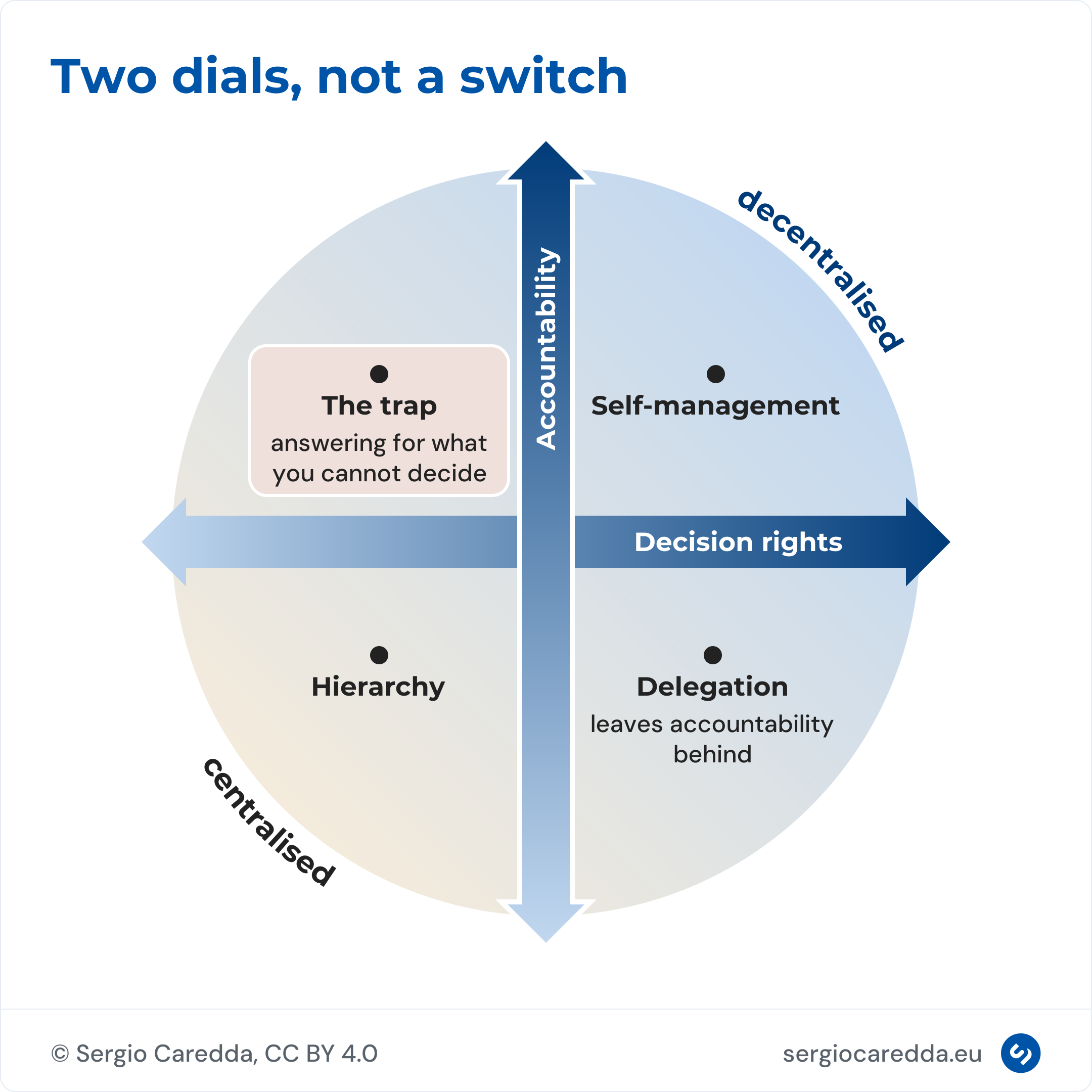
To see where a company sits, I find a map more useful than an ideology. Two dials, not switches: decision rights (how far down a decision can be taken) and accountability (how far down someone answers for the outcome). Responsibility for doing the work stays at the periphery in every version. Self-management is one region of the map, hierarchy another, and the corner where people answer for outcomes they had no right to decide is the trap I already described in Issue 63. Whether a position works then depends on agency, people’s capacity and will to act, which grows only where the accountability is real.

Power is not money
The session that stayed with me most was not a keynote. In a collaboration round on company ownership design, Lisa Schemmerling and Gijsbert Koren, working with Purpose, started from a simple picture: ownership is a bundle of two rights. Voting rights are power: who steers. Economic rights are money: who takes the profit. We are used to seeing them tied together, so that whoever owns a company both decides and collects. Steward-ownership unties them.
Bosch is the oldest example they showed. Robert Bosch wanted his company to stay self-determined and independent for the long term, connected to the family and its values, run by owners acting as stewards rather than investors, and giving back to society. The structure that delivers it splits the bundle: an industrial trust holds some 93% of the voting rights and no economic rights, a charitable foundation holds the economic rights and no votes, and the family keeps a minority of the votes. Patagonia did the same in 2022, with a purpose trust holding all the votes and a charitable collective receiving the profits. BuurtzorgT, closer to this network, moved to steward-ownership in 2020.
They framed it as two principles. Self-determination: control stays with people close to the company, and it cannot be inherited, bought or speculated on, only passed on in trust. Purpose orientation: profit is a means, and value cannot simply be extracted by shareholders; it is reinvested, donated or used to pay for capital. Each came with a question I liked more than any answer: who is the right steward? and what is enough?
This is the Grant Paradox solved at the top of the company. If nobody can buy the votes, nobody can buy the right to recall the grant. Ries’s incorruptible company is the same idea, seen from the investor’s side.
Here I owe a correction to my own framework. In the Organisational Grammar I defined Ownership as the condition above every design: who holds the residual claim on an organisation’s value and, through that claim, ultimate authority over its direction. That “through” is precisely the bundle the session untied. Steward-owned companies show that the claim and the authority can sit in different hands, and that where they sit is itself a design choice. The Grammar owes a lot to a remark Francesco Frugiuele made in a workshop on self-management last June, “the company still has an owner”, and he was in Amsterdam too, running a session on consent. The remark still holds. The session adds the next question: which owner, of which right?
Their last slide went one step further: participation is not a switch either. Between having information and holding a majority of the votes runs a whole ladder: information rights, an obligation to consult, an obligation to seek consent, special vetoes and red lines, a minority of votes, a blocking minority, a majority. It is the decision-rights dial of my map, drawn for owners instead of employees, and its middle rung, the veto without the power to propose, is the position I described in Issue 63.
The speakers also showed research on foundation-owned companies (Steen Thomsen and colleagues) to argue that steward-owned firms survive longer and keep their people longer. I note it without leaning on it: those studies are about who owns firms, not about how they organise Work.
Binding the grant twice
Unbundling ownership binds the company.
It does not, on its own, bind the freedom inside it.
Steward-ownership answers whose organisation?; it does not answer who decides inside it. Exactly as I described in the Organisational Grammar, Ownership and Work are the two transversal conditions that make or break any “model”, and there needs to be consistency between them. So a grant of autonomy has to be bound twice: at the top, so that no new owner can recall it, and inside, so that no new chief executive can.
Jon Elster called this kind of move a Ulysses clause: tying yourself to the mast because you know the sirens are coming. Inside the company, the room showed two ways of doing it.
Abolishing the post that could revoke it. EPPO has no chief executive whose successor could cancel the model.
Moving the economic half of the bundle to the periphery. VGL’s profit-sharing mini-enterprises, and Haier’s micro-enterprises with equity-like shares, make the grant something people own rather than something they are lent. Which raises the question I have not stopped asking since VGL’s talk: what do we do with pay, once the ladder goes? In the Pay Lab run by Rosien van Toor, I saw ten alternative ways organisations have set pay. None of them is an answer on its own: pay is one more piece the model has to keep consistent.
None of these has yet met its test: EPPO has removed the post a successor would inherit, which is not the same as surviving one.
Anderson’s line about freedom and accountability is the same point from the other side. And Bayer, read through the bundle, deserves one precise sentence that corrects my own LinkedIn post: its Dynamic Shared Ownership moves a share of the power and none of the money. It is decentralisation by delegation, the largest documented one. Some people in the room were sceptical, reading it as cost cutting with a better name; the fair test is the one they applied. Is the work being redesigned, or only the org chart?
I think the most honest answer came from Bill himself, when asked whether the model will last. The transformation started because it made business sense; now that people have experienced working with less bureaucracy, nobody would accept the old model coming back. Bayer is an example of a more “traditional” alignment between a board representing shareholders and the transformation the company is going through, and it suggests a third kind of binding: not written into ownership or into the structure, but into what people, once they have lived it, would no longer accept.
Whether that holds when the business case weakens is the test still to come. And the cost was real, for one group in particular: Bayer has gone from about 15,000 managers to roughly 5,000, and many of those who lost their managerial role left the company. A grant made to the many is also a role taken from some.
From ideology to coherence
The most important change I saw in Amsterdam was not in the cases. It was in the movement’s own position.
In their new book, due in March 2027, Joost and Pim describe four ways of organising, drawn from the anthropologist Alan Fiske’s four relational models: hierarchy (still most companies), equality (EPPO as an example), market (Haier as an archetype) and community (Buurtzorg again as an example). The old binary, hierarchy bad and self-management good, is gone. Joost’s comment on stage was the sharpest:
choose one dominant model, deliberately, but never a pure one, because purity is where the cult risk begins.
To me, this is the biggest move Joost and Pim have made for the network: admitting that hierarchy can serve its purpose. The movement is no longer advocating a morally superior alternative to hierarchy. It is offering a choice.
I read it as convergence, not as credit. Contingency theory has argued that the right structure depends on the situation since Burns and Stalker (1961) and Lawrence and Lorsch (1967), and I tried to say something similar when I wrote about the true meaning of hierarchy back in 2020. What is new is the movement saying it. The sense of moral superiority that clung to self-management came, as I wrote in my review of Laloux, more from his followers than from the book itself.
If no model is superior, what decides? Coherence. A model works when it fits the purpose of the organisation and the relationship people have with their work, the meaning they find in it. Net Protections’ line about care and performance says that second half better than I can. This is a design position, not evidence that coherent companies perform better, and I will not pretend otherwise.
So the golden age depends on two conditions. Coherence, so the model fits what the organisation is for and what work means to its people. And binding, so the choice survives the handover. The two meet at the handover, because that is where coherence is usually lost: a successor arrives with an intent the model was not built for. Which is why Moriani’s point about designing the transition with intent, and with courage, matters more than it sounds.
What could make me wrong
Four objections are serious. Founder-led firms are the ones most likely to try radical models at all, so the reversals may cluster at the founder’s exit for that reason alone. Lee and Edmondson (2017) and Frank Martela (2019) find these models fit best where interdependence is low, expertise is high and motivation is strong, and many organisations do not look like that. And absence of diffusion is not evidence of failure: a model can be right for few companies and still be right.
And the classic case cuts the other way: Oticon’s spaghetti organisation outlived Lars Kolind’s departure in 1998 and, according to IMD’s case series, was untangled only when growth made it too fragmented and costly, a story about scale rather than handover.
What can you do on Monday?
When Hubert Joly ended Best Buy’s programme, he explained it rested on the premise that “the right leadership style is always delegation”. He had a point, though not the one he meant. Binding a grant is not just delegation. Delegation moves a decision; binding moves the right to take the decision back. So the first moves are not structural.
Name who can take it back. For each freedom people have today, write down who could withdraw it, and with what act. Few organisations have ever written it down.
Move that right up the ladder. Take the right to revoke from “the chief executive decides” to an obligation to consult, and then to the consent of those affected. That is a change in governance, not a reorganisation.
Line up pay, and the people who lose a role. Check that pay and incentives reward what the new model asks for, and decide in advance what happens to those whose role the grant removes.
Only then, ask the owners. If the people who own the company could recall the grant, the conversation is about Ownership, and it is a longer one.
The above applies to any practice. Just think about your remote working arrangements. And how often they have been simply “pulled out” by a policy change with the arrival of a new boss. Defining not just the space of freedom, but the rules governing it is, after all, a principle for some of the more radical models (like the constitution in holacracy), exactly because they feel the need to establish the framework first-hand. A manager that delegates is exactly like the well-intended sovereign who gave some autonomy to his subjects. Everything could be taken back.
Yet, and this is my final advice, also as a “middle manager” you can set spaces of freedom with your team and peers. Exactly by enabling a thorough discussion on the rules of the game. Most Agile implementations that worked came this way.
What the golden age depends on
Gary Hamel reached the same place by a different road. In his Drucker Forum remarks this month he lists the pioneers, from Semco and Gore to Haier and Buurtzorg, and concludes:
we are still stuck: there are not enough post-bureaucratic rebels to make a difference.
His diagnosis is close to mine. Progress, he argues, should not depend on "the occasional, fortuitous union of a heterodox CEO and a troubled but obliging company." That is the Grant Paradox, seen from outside. Where we part is the remedy. Hamel wants to scale up, a GitHub for management and thousands of low-risk experiments. I want them too. But an experiment allowed by a heterodox chief executive is still a grant, and multiplying unbound grants multiplies what the next one can take back. Scale without binding is just a bigger hangover.
So, to Pim’s upswing. I hope he is right, and I think he may be. But it becomes a golden age only if this wave chooses its models coherently and binds its grants, not if it recruits more believers.
In another working session, some people asked the right question: how is our jargon keeping people out? It is their question, and a good one, and I have tried to answer it here with two terms rather than ten. Behind both sits a test I have used throughout this newsletter and in my entire vision of organisation effectiveness: whether a design holds its consistency, congruence and coherence.
The next summit is in Milan, which gives me a year to see whether the grants being made today are being written into something the next leader cannot take back.
Which leaves me with a question for you. In your organisation, who could take back the freedom people have today, and how long would it take them?
Sergio
References
Zucca, A., Bieber, K., Ghignone, E. and Solari, L. (2026). Il ruolo necessario degli artefici della libertà del self-management. Harvard Business Review Italia, luglio-agosto 2026.
Lee, M.Y. and Edmondson, A.C. (2017). Self-managing organizations: Exploring the limits of less-hierarchical organizing. Research in Organizational Behavior, 37, 35–58.
Martela, F. (2019). What makes self-managing organizations novel? Journal of Organization Design, 8, 23.
Hamel, G. and Zanini, M. (2020). Humanocracy. Harvard Business Review Press.
Elster, J. (1979). Ulysses and the Sirens. Cambridge University Press. ]
Burns, T. and Stalker, G.M. (1961). The Management of Innovation. Tavistock.
Lawrence, P.R. and Lorsch, J.W. (1967). Organization and Environment. Harvard University Press.
Thomsen, S. et al. (2018). Industrial foundations as long-term owners. Corporate Governance: An International Review, 26(3).
Hamel, G. (2026). Inventing the Future of Management - Remarks delivered at the Global Drucker Forum, Vienna, Austria, November 4, 2026. LinkedIn.
2. Site Updates
Two sets of additions this fortnight, both close to this issue.
The “AI and” pages are now four. AI and Work and AI and Talent, which I introduced last time, are joined by AI and HR, on how AI is taking away the information advantage HR’s operating model was built on, and AI and Organisation Design, on the question this issue keeps circling: once AI arrives, every organisation has to say who decides, and who answers for the decision. All four are living pages, updated as the evidence moves.
Three new entries in the collection. Communityship, Mintzberg’s alternative to heroic leadership, where strategy forms on the ground rather than at the apex. Bain’s Operating Model for the Age of AI, whose claim that the org chart becomes an accountability chart sits right on the map above. And Polymorphic Organisations, Perry Timms’s repertoire of forms held together by a constant purpose: the closest thing in the collection to the choice, rather than conversion, that the Corporate Rebels are now arguing for.
3. Reading Suggestions
When your company needs a new leader, ‘Insider or Outsider?’ is the wrong question — Rita McGrath, Thought Sparks, on Substack. The handover question from the board’s side: before choosing who comes next, decide whether the company has lost its purpose, needs a new one, or needs a better way to deliver it. Read it as the successor’s half of this issue.
AI Is Rebuilding the Organisation. Who’s Going to Manage It? — Stuart Winter-Tear, Unhyped AI. If AI makes the organisation, not just the individual, smarter, then who decides and who answers has to be designed again. The same two dials as the map above, arriving from the technology side.
Want Employees to Embrace AI? Stop Selling It as a Productivity Tool — Stanford HAI. People adopt what makes their work more meaningful, not merely faster. A useful companion to the coherence argument: a model fits when it fits what work means to the people doing it.
Working with AI — Nathan Wilmers, Maxim Massenkoff and Peter McCrory, Anthropic. Interviews with 66 people at 58 US companies using AI. The highest-value uses were the ones that changed processes or roles, and the real bottleneck turned out to be human review of what the machines produce. A vendor studying its own customers, so read it as a signal, not proof. But the pattern is the one this issue argues for: the gains come from redesigning who does what, not from the tool.
The library of organizational structures and models — Peerdom. From hierarchy to Holacracy, Spotify and SAFe, each described on its own terms. After an issue about choosing a model rather than converting to one, a good place to see how many there are to choose from.
Specific and General Knowledge, and Organizational Structure — Michael C. Jensen and William H. Meckling, Journal of Applied Corporate Finance, 1995. The scientific pick. Decision rights work best where the knowledge to use them sits, and every organisation has to choose between moving the knowledge and moving the rights. Thirty years before the summit, the economic case for the decision-rights dial.
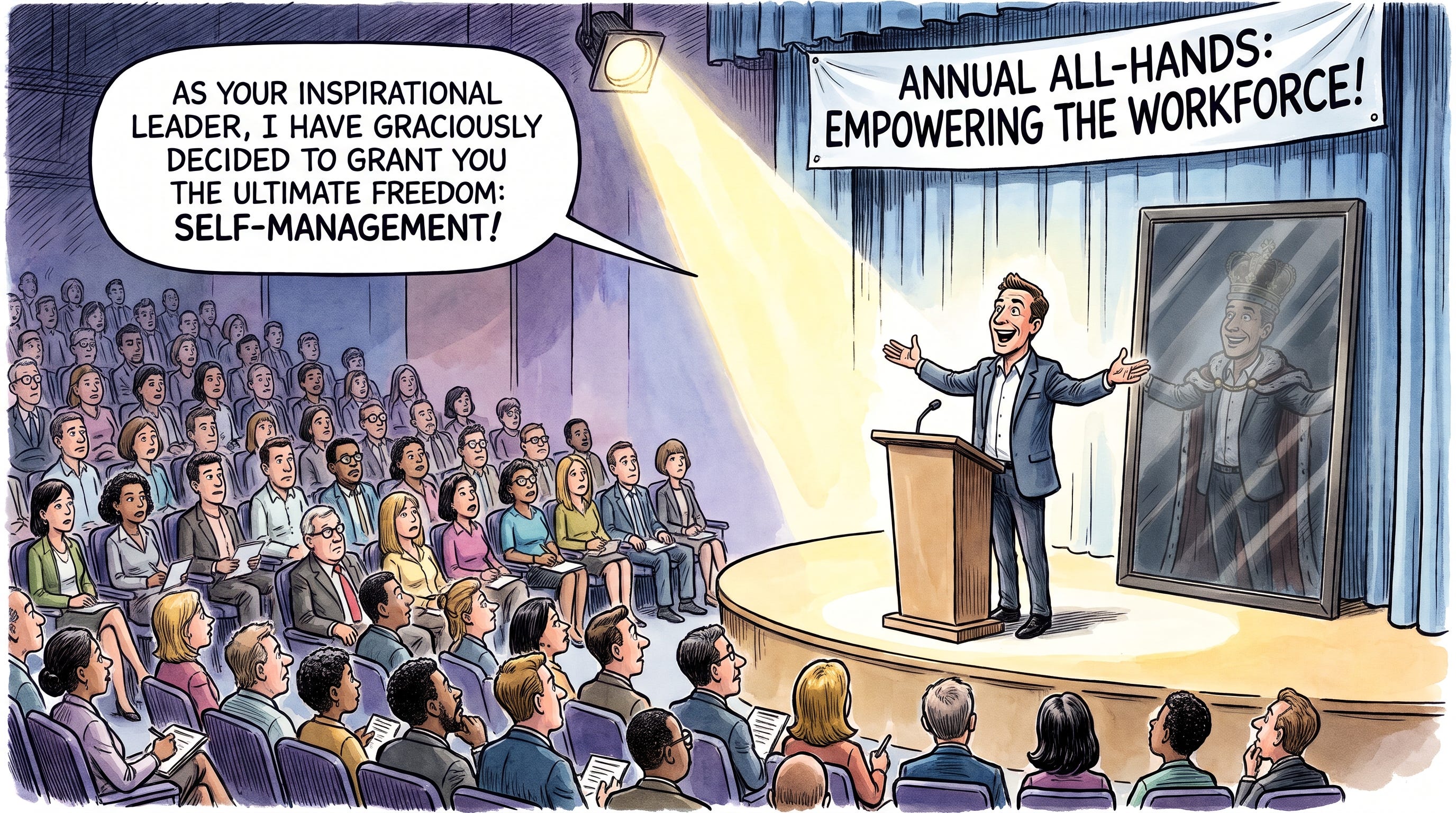
4. The (un) Intentional Organisation 😁
5. Keeping in Touch
Don’t hesitate to reach out by directly hitting “reply” to this newsletter or using my blog’s contact form.
I welcome any feedback on this newsletter and the content of my articles.
Find me also on:
"Name who can take it back" is such a practical place to start. I think people feel this even when no one says it. If they sense a freedom could disappear w/ the next leader, they hold back from really using it. Writing it down, like you suggest, Sergio, seems like a kind thing to do for everyone involved.